Auto Repair SEO Cost, Is It Worth It?

Auto Repair SEO Cost, Is It Worth It?

Is SEO Worth $1,000 to $1,500 a Month for a Small Auto Repair Shop?

A practitioner's breakdown of auto repair SEO cost, what the spend actually buys, and how to tell an investment from a leak.

A shop owner forwards me a quote almost every week.

Some agency wants $1,200 a month for SEO.

Twelve-month contract. The owner reads it, gets a knot in his stomach, and asks the only question that matters: is this an investment, or a leak I won't notice until the bank balance tells me?

That is the real question. Not "does SEO work." SEO works.

The question is whether this spend, on this shop, at this moment, is money put to work or money quietly draining out the back.

Those are very different things, and the quote in your inbox does not tell you which one you are looking at.

So let's run it the way you'd run a diagnostic on a car that's pulling to one side.

We're not going to guess. We're going to check the actual systems, look at the actual numbers, and tell you what the readings mean.

By the end you'll be able to look at that $1,200 quote and know whether to sign it, renegotiate it, or put it down and fix something else first.

What $1,000 to $1,500 a Month Actually Buys

Mechanic shop SEO pricing is all over the map, and the spread is not random. It tracks what you actually get. Here is the honest market, from a shop owner's point of view.

Price range What it usually is Who it fits
DIY / $0 to $100/moYou optimize your own Google Business Profile, post updates, ask for reviews by hand. Maybe a cheap tool.An owner with real time and discipline. Most owners do not have either.
$300 to $600/moLocal SEO basics: GBP management, a handful of optimized pages, review requests, light reporting.A single-bay-heavy shop testing the water, or one with a clean intake system already in place.
$1,000 to $1,500/moMid-tier local SEO: GBP optimization, service and city pages built on purpose, an active review engine, monthly content, real call tracking.An established shop with a working front desk that wants to own its local map, not just appear on it.
$1,500 to $2,500+/moFull-service: everything above plus aggressive content production, link work, multi-location coverage, sometimes paid traffic bundled in.Multi-location operators or shops in genuinely competitive metros.

Here is where shop owners get burned. They pay a $1,200 mid-tier price for what is functionally a $400 service. The agency manages the GBP, sends a few review texts, publishes one thin blog post a month, and reports on "impressions." The price says investment. The deliverables say leak.

The opposite mistake is just as expensive. An owner pays $1,500 a month for a full-service package while the shop's phone still goes to voicemail at lunch. That is paying for the Road while ignoring the fact that the car can't start. We'll come back to that, because it's the single most common reason SEO money gets wasted.

The first read: $1,000 to $1,500 a month is a fair price for real mid-tier local SEO. It is a terrible price for managed-GBP-plus-a-blog-post. The number on the quote tells you nothing. The deliverables list tells you everything.

The Real Question Is Not "Is SEO Worth It." It Is "Which Part of Your Shop Is Leaking?"

The Real Question Is Not Is SEO Worth It. It Is Which Part of Your Shop Is Leaking

Most shops do not have a marketing problem. They have a leak problem.

Money is already going out the door, on a website, on some ads, on a guy who does "the Google stuff," and the owner cannot see where it's draining.

SEO is one component of a marketing engine. Buying it in isolation, without knowing which part of the engine is actually broken, is how good money gets spent on the wrong repair.

We diagnose this with six checkpoints. Think of them as the engine's subsystems. They have a build order, and the order is not optional.

Reliability, Reputation, Reselling, Readiness, Remarketing, Reach

That is the order you build in, from the inside out.

Reliability is the work itself: if the shop can't deliver, marketing just sends more people to a bad experience.

Reputation is what the market says about you when you're not in the room: your reviews, your stars, your velocity.

Reselling is the revenue sitting in your customer database, people who already trust you and haven't been back in a year.

Readiness is what happens when a lead actually shows up: does the phone get answered, does the form get routed, or does it sit in an inbox until Thursday.

Remarketing is the follow-up on the prospects who didn't buy the first time.

And Reach, the last one, is the audience your shop touches: paid traffic, social, and the one you're here for, SEO.

SEO is Reach. Reach is the R you build last. Not because it doesn't matter.

Because pouring fuel into an engine that can't convert it is the most expensive mistake in auto shop marketing.

SEO brings more people to your storefront. If your storefront, your reviews, your phone coverage, your follow-up, can't catch them, you have just paid $1,200 a month to introduce more strangers to your weakest moment.

The honest version: if your shop sits at 40 reviews while the shop across town has 200, or your missed calls go to voicemail and stay there, SEO is the wrong purchase this quarter. Not forever. This quarter. Fix the cheaper leak first, then SEO compounds instead of evaporates.

This is the part most agencies will not tell you, because they sell SEO and SEO is what they want you to buy. But a tactic sold without a diagnosis is a guess with an invoice attached.

The reason to run the six checkpoints first is simple: it tells you whether SEO is the best place for your next dollar right now, or whether $400 spent on a missed-call text-back system would do more for your car count this month than $1,200 on rankings.

The Math, Run the Way a Shop Owner Runs It

The Math, Run the Way a Shop Owner Runs It

You think in average repair order, car count, bay capacity, and ticket average. So let's price SEO in those terms instead of marketing terms. Say your average repair order is $450.

Say your shop nets, after parts and labor, somewhere around 50 percent on that work, so call it $225 of gross profit per RO.

Those numbers vary, plug in your own, but the structure holds.

At $1,200 a month for SEO, your breakeven is not abstract. It is between five and six repair orders a month that you would not have gotten otherwise. That's it. If local SEO brings you six extra cars in a month, the channel paid for itself and the rest is yours.

5 to 6 ROs — the monthly breakeven on a $1,200 SEO spend, at a $450 average repair order and 50 percent gross margin. Everything past that is profit the channel produced.

Now look at the other side of the ledger: cost per lead.

A well-built local SEO program does not just produce leads, it produces cheaper leads over time, because organic rankings and a strong Google Business Profile do not charge you per click.

That is not a discount. That is the channel compounding: the same work that ranked you keeps ranking you, and the lead cost keeps dropping while the lead count climbs.

Compare that to paid ads, where the meter resets every morning. Stop paying, the leads stop that day. SEO has mileage. The content you publish this quarter is still working eighteen months from now.

That is the difference between fuel you burn and equity you build, and it is the entire reason the channel can be worth a four-figure monthly spend even though it feels slow at the start.

The math only breaks in one situation: when the leads SEO produces fall through a leak before they become repair orders.

Which is why the breakeven number above assumes your front desk actually catches the calls.

If it doesn't, recalculate. Your real cost per acquired customer is whatever you paid divided by the few that made it through, and that number can get ugly fast.

What Good Local SEO Actually Includes

If you are going to spend $1,000 to $1,500 a month, you should be able to point at what you are buying. Real mid-tier local SEO for an auto repair shop has three load-bearing components. If a package is missing one, you are paying for activity, not assets.

Google Business Profile optimization, treated as your storefront

1. Google Business Profile optimization, treated as your storefront

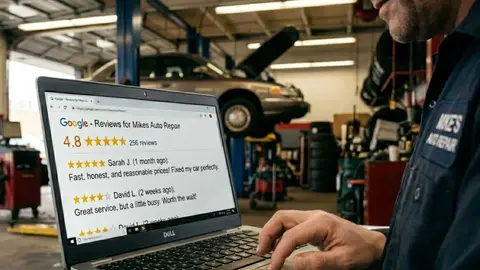
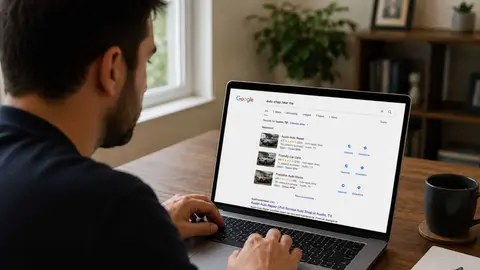
Your GBP is the most visible public-facing asset you own. It is your showroom on the digital street. For a "mechanic near me" search, the map pack shows up before the regular results, and most clicks never go past it. Good SEO work means the profile is fully built out, categorized correctly, posting regularly, photographed well, and collecting reviews on a system instead of by accident. We have seen GBP map views go from a few hundred a month to north of seventeen thousand once a profile is actually managed instead of just claimed. That visibility is free traffic, and most shops leave it sitting on the table.

A hub-and-spoke page structure, not one thin Services page

2. A hub-and-spoke page structure, not one thin "Services" page

This is the part cheap packages skip. A hub-and-spoke build means one strong page for a service, the hub, connected to multiple pages targeting the specific towns you serve, the spokes. Brake repair is the hub. Brake repair in your town, brake repair in the next town over, those are the spokes. It builds topical authority and geographic coverage at the same time. A single page that says "we do brakes, AC, diagnostics, and more" ranks for almost nothing, because it is trying to be about everything and ends up being about nothing.

A review engine that runs on a system, not on the owner remembering

3. A review engine that runs on a system, not on the owner remembering

Review velocity, the steady drip of fresh reviews, matters as much as the total count. Google rewards consistency, and so do customers reading them. Good SEO work includes the system that asks every customer, every time, automatically. Reviews are the cheapest, highest-return trust asset a shop owns, and they feed your rankings and your conversion rate at the same time.

How to audit a quote in thirty seconds: ask the agency to point at the GBP plan, the page structure, and the review system. If they get specific, you're looking at real local SEO. If they answer with "content" and "optimization" and "authority building," you're looking at a $400 service wearing a $1,200 price tag.

The Timeline: Why SEO Feels Like Nothing, Then Feels Like Everything

The Timeline Why SEO Feels Like Nothing, Then Feels Like Everything

Here is the part that makes shop owners nervous, and the part bad agencies hide. SEO does not work like ads.

You will not see a result in week two. The honest timeline is three to six months before the curve bends, and the first sixty days can feel like you're paying for nothing.

That is because rankings do not move in a straight line. They move in steps. Google re-indexes, re-evaluates, and then a body of work that looked like it was doing nothing moves all at once.

We watched this on a Southern California RV service and paint operation we work with. For weeks the rankings looked flat. Then a single indexing cycle hit.

15.1 to 4.2 — average organic rank for a Southern California RV service and paint operation, moved in a single indexing cycle and held for seven straight months. The work looked like nothing, until it looked like everything.

That same operation now holds 99 percent of its tracked local pack rankings in the top three, and 49% are at the number one spot. Its monthly website sessions grew 6.5 times over the build.

None of that happened in month one. All of it happened because the work in months one through three was real, even when the dashboard looked quiet.

So the timeline is a feature, not a bug, but only if you understand it going in. The owners who get burned are the ones who were sold a fast result, panicked at the month-two report, and either fired the agency right before the step change or kept paying an agency that was never building anything in the first place.

You need to be able to tell those two situations apart, which means you need leading indicators in your monthly report: pages published, reviews added, map views, query impressions.

Those move before rankings do. If those are climbing, the engine is being built. If those are flat too, that is your answer.

SEO Is Digital Real Estate, and It Has a Replacement Cost

SEO Is Digital Real Estate, and It Has a Replacement Cost

Before this work, I spent years as a real estate appraiser. The instinct never left. When I look at a shop's digital presence, I see an asset with a calculable value, the same way I'd look at a building.

Your page-one rankings, your map pack positions, your reviews, your content library, those are digital real estate.

Fixed supply, variable demand.

There are only three slots in the map pack for "transmission repair near me" in your town.

If you hold one, your competitor does not.

And like any property, that position has equity that compounds and a replacement cost if you lose it.

Here is what that equity looks like in dollars.

An independent European auto repair shop in the Inland Empire we work with pulled 629 organic clicks in a stretch where the going rate for that same click through Google Ads was $2.35.

$1,478 — the paid-traffic cost an independent European auto repair shop in the Inland Empire did not have to pay, because 629 visitors arrived through organic rankings instead. Every organic click is a dollar you didn't hand to Google.

Run that forward. That is not a one-time saving. Those rankings keep producing clicks next month and the month after, at no additional cost per click, while the paid meter would have kept running.

That is the compounding nobody puts on a quote, because it does not show up in month one.

It shows up in year two, when a shop that invested in SEO is pulling free traffic that a shop relying purely on ads is still renting by the click.

This is also why "is SEO worth it" is the wrong frame.

You would not ask if owning the building is "worth it" versus renting forever.

You'd ask whether you can afford the down payment and whether the location is right.

SEO is the same decision. The monthly fee is the mortgage payment on an asset you are building.

The question is whether the shop is in a position to make that payment count.

Red Flags: When That $1,200 Is a Leak, Not an Investment

The spend is not the problem. The wrong spend is. Here is what tells you a $1,200 SEO engagement is going to drain instead of build.

The tactic-seller

The tactic-seller

Any agency selling one channel as the whole answer. SEO-only, with no interest in whether your phone gets answered or your reviews are current, is selling you a wheel and calling it a car. The channel might be fine. The isolation is the problem.

Software dressed up as strategy

Software dressed up as strategy

A platform or a parts company that sells you a tool and calls it marketing. The tool might be useful. A tool is not a strategy, and paying strategy prices for software access is a quiet, recurring leak.

Reporting on impressions and clicks instead of calls and cars

Reporting on impressions and clicks instead of calls and cars

If the monthly report leads with "impressions" and "rankings" but cannot tell you how many phone calls or booked appointments the work produced, the agency is hiding behind vanity metrics. You measure your shop in cars and ROs. Your marketing should be measured the same way.

No call tracking, no conversion tracking, no attribution

No call tracking, no conversion tracking, no attribution

If nobody installed the plumbing to see which leads came from where, then nobody, including you, will ever know if the $1,200 worked. That is not an oversight. That is a leak with a contract.

The fragmented vendor blame cycle

The fragmented vendor blame cycle

You have an SEO guy, a website guy, and an ads guy, and when results are flat the SEO guy blames the website, the website guy blames the ads, and nobody owns the number. Three invoices, zero accountability. The fix is not a better SEO vendor. It is one accountable system.

So Is It Worth It? The Honest Answer

So Is It Worth It The Honest Answer

SEO is worth $1,000 to $1,500 a month for a small auto repair shop when three things are true.

The work is real mid-tier local SEO, not a managed GBP with a price markup.

The shop underneath it can actually catch the leads, so the front desk answers, the reviews are competitive, the follow-up exists. And the owner understands the timeline, so the step change in month four does not get killed by panic in month two.

When those three things are true, the channel compounds.

Cheaper leads over time, free traffic that keeps producing, an asset with real equity.

When even one of them is false, that same $1,200 is a leak you will not notice until the year-end numbers make you look.

The quote in your inbox does not tell you which situation you are in. A diagnosis does. Before you sign a twelve-month SEO contract, find out which part of your shop is actually leaking, because that is the part worth fixing first.

What would SEO have to produce to pay for itself at your shop?

Quotes get priced in impressions. You run your shop in cars. Put your numbers in.

$
%
$
%
If you caught every call

5.3

repair orders
Each car returns $225. A $1,200 spend pays for itself at 5.3 cars a month.
What SEO actually has to deliver

6.6

opportunities
You keep 80% of what the channel brings, so it has to produce 6.6 to net 5.3.
Why this number is still conservative

Missed calls are the only leak counted here, because missed calls are the only one that is plain arithmetic. Miss a quarter of your calls and the channel has to produce a third more to land the same work. No estimating required.

Two other leaks are working on you at the same time, and we are not going to pretend we can put a number on them. If you have no follow-up for the people who call once and do not book, some of what you paid for walks. If your review count sits well behind the shop across town, some of the people who find you in the map pack pick them instead, and you never see it happen.

We do not know the size of either effect at your shop, and nobody honestly does without looking at your numbers. But we know the direction, and it only ever runs one way: both push the real number higher than what is shown above. Treat this as the floor, not the estimate.

Math: spend divided by (repair order times margin) gives the breakeven. That divided by your call capture rate gives what the channel has to produce. A planning tool, not a projection, and not a guarantee of results.

The cheapest way to lower this number is not to negotiate the SEO price. It is to stop dropping the calls you already pay for.

Book a shop audit

Frequently Asked Questions

How much does SEO cost for an auto repair shop?

Auto repair SEO cost runs from near zero for a disciplined DIY effort, to $300 to $600 a month for local SEO basics, to $1,000 to $1,500 a month for real mid-tier work with GBP optimization, purpose-built service and city pages, and a review engine, up to $1,500 to $2,500 or more for full-service or multi-location coverage. The price only tells you something when you read it against the actual deliverables list.

How long before auto repair SEO actually works?

Plan on three to six months before the curve bends. Rankings move in steps, not a straight line, because Google re-indexes and re-evaluates in cycles. The first sixty days can feel like nothing is happening even when the foundational work is real. Watch leading indicators, pages published, reviews added, map views, and query impressions, because those climb before rankings do.

Is local SEO better than Google Ads for a mechanic shop?

They do different jobs. Google Ads is fuel: it produces leads immediately and stops the day you stop paying. SEO is equity: it builds slowly, then keeps producing traffic at no additional cost per click. Most shops eventually want both, but the order matters. Neither one is worth the spend if the shop cannot catch and convert the leads they bring in.

Can I just do SEO myself instead of paying an agency?

You can handle the basics yourself, optimizing your Google Business Profile, posting regularly, and asking every customer for a review. That alone puts you ahead of plenty of shops. The work that is hard to DIY is the page structure, the content cadence, and the consistency, because those compete with your actual job of running a shop. The honest test is whether you have real time and real discipline. Most owners have neither, and that is not a knock, it is just the reality of running a bay.

Why is my current SEO not producing more calls?

Usually one of three reasons. The work being done is thinner than the price suggests. Or the SEO is fine but the leak is somewhere else, the phone goes to voicemail, the reviews are not competitive, the follow-up does not exist, so the traffic arrives and falls through. Or there is no call tracking installed, so the calls are happening and nobody can see them. A diagnosis tells you which one it is.

How do I know if an SEO agency is worth the money?

Ask three specific questions. What is the Google Business Profile plan, what is the page structure, and what is the review system. Specific answers mean real local SEO. Vague answers about "content" and "authority" mean you are likely paying a mid-tier price for an entry-level service. Then check the reporting: if it leads with impressions instead of calls and booked appointments, the agency is measuring the wrong thing.

Expanded Your Business Next Door? Don’t Make This Critical Google Profile Mistake.

Expanded Your Business Next Door? Don’t Make This Critical Google Profile Mistake.

Your business is thriving. So much so, you’ve just expanded by purchasing or leasing the storefront right next door. Congratulations! This is a huge milestone.

After the paperwork is signed and you get the keys, your first marketing instinct is to go to Google and "claim" your new address.

Stop right there.

This is a critical moment for your local SEO, and your next move will either strengthen your online presence or create a confusing digital mess that can hurt your business for years. As someone who works with business owners on this exact issue, I want to share the right way to handle it.

The Core Principle One Business One Profile

The Core Principle: One Business, One Profile

Google's most important rule for local businesses is simple: One contiguous business gets one Google Business Profile (GBP). Even if you have two separate lot numbers, two front doors, or two legal addresses, you are operating as a single company. Creating a second GBP for your new space is one of the most common—and damaging—mistakes an expanding business can make. It's crucial to consolidate your strength, not dilute it.

Why Creating a Second Profile is a Mistake

Why Creating a Second Profile is a Mistake

It Splits Your SEO Power

Your reviews, photos, ranking authority, and customer history are all tied to your original GBP. A new profile starts from zero, effectively cutting your online reputation in half.

It Confuses Customers

Which door do they use? Which profile do they leave a review on? This confusion can lead to frustration and lost customers.

It Invites Google Penalties

Google sees two profiles for one business as a "duplicate listing." This can cause one or both of your profiles to be suspended or have their ranking suppressed.

Step 1 Neutralize the Ghost Listing

Step 1: Neutralize the "Ghost Listing"

Before you announce your expansion, you must deal with the past. The business that was in your new space before you probably still has a Google Business Profile—a "ghost listing." First, search on Google Maps for the exact business name and address of the former tenant. Then, on their public profile, click "Suggest an edit" and choose the option to "Close or remove," selecting "Permanently closed" as the reason. This step is non-negotiable. It cleans the slate, prevents old customers from showing up confused, and tells Google that a new era has begun at that address.

Step 2 Update Your Existing Google Profile

Step 2: Update Your Existing Google Profile

All your updates will happen on your original, established GBP. Do not change your primary address. Instead, use your profile's features to tell the story of your growth.

Update Your Description

Go to your profile's "Info" section and edit your business description. Add a sentence like: "We're thrilled to announce our expansion into the space next door! This allows us to offer [new services, more products, a larger waiting area, etc.]. Our main entrance remains at [Your Original Address]."

Upload New Photos (Your Most Powerful Tool)

Photos are proof. Take and upload high-quality pictures of the exterior showing both storefronts, new signage covering both units, and photos of the newly renovated and connected interior spaces.

Create a "What's New" Post

Use the Google Posts feature to create a formal announcement. Title it "We've Expanded!" and include your best photo of the new, larger space to showcase the change.

Step 3 Broadcast the News Everywhere Else

Step 3: Broadcast the News Everywhere Else

Your GBP is the centerpiece, but your entire digital footprint needs to be consistent.

Your Website

Your "Contact Us" page should still list your single, primary address. Create a blog post or a banner on your homepage announcing the expansion to inform your website visitors.

Online Directories

Ensure your listings on Yelp, Angi, and other industry sites all use your primary business address. Consistency is key for local SEO and builds trust with search engines. Find out if local SEO is worth it for your auto shop.

Physical Signage

Don't underestimate the power of real-world signals. Invest in clear, professional signage that spans both properties, making it obvious you are one, unified business. Google's own Street View cars will eventually see this and use it to confirm the information.

The Takeaway Grow Smarter

The Takeaway: Grow Smarter

Expanding your physical space is a sign of success. By managing your digital presence as thoughtfully as your physical one, you ensure that growth translates directly into a stronger online reputation, better search rankings, and a clearer, more professional image for your customers. Consolidate, don't duplicate. That's how you win.

Is Your Staff Asking for Reviews at the Checkout Counter? Stop Now.

Is Your Staff Asking for Reviews at the Checkout Counter? Stop Now.

Imagine waking up one morning to find 800 of your hard-earned Google reviews had vanished overnight. Poof. Gone. For one business, this wasn't a bad dream—it was a reality. Their profile went from 1,200 reviews to 400, and Google slapped a 30-day restriction on their account, preventing any new reviews from coming in.

What was their crime? Something you might be doing right now: asking customers for a review at the point of sale.

I’ve been seeing this pop up more and more. Experts in the SEO world I follow, like Barry Schwarz and Mike Blumenthal, are reporting a huge spike in Google Business Profile suspensions. Google is cracking down, and while they’re targeting spammers, many legitimate business owners are getting caught in the crossfire because of this one simple mistake.

The Violation: Pressuring Customers at Checkout

pressuring for reviews

The whole issue comes down to Google's "Fake Engagement Policy." In their eyes, asking someone for a review while they’re standing at the register, phone in hand, is a form of pressure. It doesn’t feel voluntary to them.

The case I mentioned earlier was brought to light by Google Business Profile expert Claudia Tomina. The business wasn't just losing reviews; they also had a warning banner placed on their profile telling the world that "suspicious reviews were removed." Talk about a blow to your brand integrity.

So, what exactly is triggering these suspensions?

  • A Rush of Reviews: The business that lost 800 reviews was only two months old but had already racked up 1,500. A massive number of reviews in a short time looks suspicious to Google.
  • Location, Location, Location: If dozens of reviews all come from the exact same physical location (i.e., your business address), it raises a red flag. This often happens when businesses use a QR code at the register. It’s the digital version of having multiple reviews come from the same IP address, which has always been a no-no.
  • Competitors Reporting You: Google maintains a "report business conduct form" primarily used for reporting "fake review generation." One of the specific concerns a user can report on this form is "pressuring people to leave reviews." So yes, your competitors (or even disgruntled customers) can report this activity directly to Google.

How to Stay Safe and Still Get Reviews

reviews after the sale

Look, I get it. The best time to ask for a review feels like the moment a happy customer has just paid. But you can’t risk your business profile. It’s some of the most valuable real estate in the world because it exists in your customers' minds.

So, what’s the solution? It’s simple: follow up with your customers after the sale.

Local SEO specialist Larry James puts it best: this is the only truly ethical way to ask. It means you need a system to collect a customer's email or phone number during the transaction. Then, a few hours or a day later, an automated message can go out asking for their honest feedback. This gives the customer space, removes any sense of pressure, and keeps you safely within Google's guidelines.

The rules under the Fake Engagement Policy are straightforward:

  • Don't offer discounts or freebies for reviews.
  • Don't try to filter out negative reviews.
  • Don't pressure people at the checkout counter.

If your profile has already been suspended, don’t panic. A Google expert noted that many businesses get their profiles "brought back" after they learn the rules, fix the mistake, and appeal. Often, it was just an honest "boo boo."

Use a Reputation Management System

We actually have a Reputation Management System that can email or text customers after the sale to leave a review, either automatically or manually. Please contact me for more information.

reputation management system

My advice? Take five minutes today and review your process. Talk to your staff. Make sure everyone on your team understands that asking for a review at the register is no longer an option. It’s a simple change that can protect your brand and ensure your hard-earned reputation stays intact.

The Art of Website Design: Everything is a Remix

The Art of Website Design: Everything is a Remix

I recently watched Kirby Ferguson's fascinating TED Talk on how "everything is a remix," and it completely changed how I approach website design for my small business clients. Ferguson argues that creativity isn't about conjuring something from nothing, but rather about copying, transforming, and combining existing elements into something new.

TED TALK: Creativity is a remix | Kirby Ferguson

As I reflected on my decade of designing websites for local businesses, I realized this framework perfectly describes the creative process I use when crafting the perfect online presence for my clients. Let me share how these principles apply to website design and why this matters for your business.

Copy: Finding Inspiration in What Works

Copy Finding Inspiration in What Works

When I start designing a website for a new client—whether it's a local bakery, law firm, or plumbing service—I always begin with research. I spend hours examining websites from both inside and outside their industry, identifying elements that resonate with their target audience. This isn't about copying others' work—it's about understanding what's effective.

In website design, we all stand on the shoulders of giants:

  • I study successful layouts that guide visitors naturally toward important information
  • I collect color schemes and typography combinations that evoke the right emotional response
  • I observe how similar businesses structure their content to address customer questions

When a restaurant owner worries about having a "unique" website, I often explain that customers actually prefer familiar navigation patterns. They want to find your menu, hours, and location without learning a new interface. The most successful small business websites aren't completely novel—they thoughtfully adapt what works.

Transform: Making Your Website Uniquely Yours

Of course, simply drawing inspiration isn't enough. The magic of great website design happens in transformation—adapting proven elements to reflect your unique business identity.

Before:

before

After:

after

When I designed a website for a local hair stylist last month, I started with a popular layout that customers would find intuitive. But I didn't stop there:

  • I modified the color palette to match their storefront's distinctive aesthetic
  • I customized the typography to reflect their upscale yet approachable brand voice
  • I adapted the product presentation to highlight the craftsmanship they pride themselves on
  • I adjusted the mobile experience to serve their predominantly smartphone-using customers

This transformation process is where your business personality shines through. While the underlying structure might feel familiar to visitors (making it easy to navigate), the final product feels distinctly yours because it's tailored to your business values, customers, and offerings.

Combine: Creating a Cohesive Customer Experience

The most creative part of website design lies in combination—bringing together various elements to create a cohesive experience that works for your specific business needs.

Combine Creating a Cohesive Customer Experience

For a family-owned RV repair shop I recently worked with, their website needed to:

  • Showcase their extensive service offering without overwhelming visitors
  • Highlight their knowledgeable staff (their key differentiator from generic mechanics)
  • Make it easy for RV owners to find what they need quickly
  • Emphasize their commitment to customer service and company history

By thoughtfully combining service-specific landing pages, an informative blog with RV-specific resources, and clear call to action sections, we created something unique, not because each element was revolutionary, but because they were combined in a way that perfectly reflected this specific business.

This combination approach allows your website to feel fresh and distinctive without reinventing the wheel. It's about selecting and integrating the correct elements for your business story.

Embracing the Remix Mindset for Your Business Website

Embracing the Remix Mindset for Your Business Website

Adopting this "remix" perspective can be incredibly freeing for small business owners. Many of my clients initially worry that their website won't stand out or, conversely, that it will be too experimental and confuse customers.

Understanding design as a remix helps find that perfect balance. Some of my most successful small business websites have emerged from this approach:

  • A local accounting firm whose website borrowed the clean, confidence-inspiring layout of major financial institutions but combined it with warm, personalized content and staff stories
  • A neighborhood café that adapted e-commerce product presentation techniques to showcase their menu items in a mouth-watering way
  • A family dental practice whose website combined medical professionalism with the welcoming atmosphere of hospitality sites

Your Business Story Through Thoughtful Design

Your Business Story Through Thoughtful Design

What makes your business special isn't necessarily revolutionary—it's your unique combination of products, services, values, history, and people. Your website should reflect this through thoughtful design choices.

When I work with small business clients, I help them identify their distinctive elements and then find the right design approaches to highlight them. We're not starting from scratch; we're crafting a remix that tells your specific business story in a way that resonates with your customers.

Final Thoughts for Small Business Owners

If you're a small business owner feeling overwhelmed by website design decisions, take heart. Remember that even the most impressive business websites are thoughtful remixes of existing ideas.

What matters isn't having a completely revolutionary website, but rather how well your site communicates your unique business value through smart adaptation of proven design elements. Your specific offerings, customer relationships, and business personality will naturally lead to a distinctive website when approached thoughtfully.

So embrace the remix approach to your website design. Look at sites you admire, identify elements that would work for your business, and find creative ways to adapt them to tell your specific story. That's not just how effective websites are built—it's how businesses successfully connect with customers online.

Are you planning a new website for your small business? I'd love to hear about your vision and help you navigate the design process. Reach out for a free consultation where we can discuss how to create the perfect online presence for your unique business.

Local Keyword Research: The Ultimate Guide for Auto Repair Shops

Local Keyword Research: The Ultimate Guide for Auto Repair Shops

In today's digital landscape, local businesses face unique challenges when it comes to online visibility. While major corporations can throw massive budgets at broad marketing campaigns, local service businesses need to be more strategic with their resources. This is where local keyword research becomes your secret weapon for attracting the right customers in your area.

What Is Local Keyword Research?

What Is Local Keyword Research

Local keyword research is the process of identifying and analyzing the specific search terms that potential customers in your geographic area use when looking for services like yours. Unlike general keywords, local keywords have a geographic component that comes in two main forms: explicit and implicit local keywords.

Explicit local keywords directly include location names in the search term, such as "plumber in Boston" or "Chicago wedding photographer." On the other hand, implicit local keywords don't mention specific locations but have local intent, like "24/7 locksmith near me" or "same-day appliance repair." Understanding this distinction helps you capture both types of searches effectively.

Why Local Keyword Research Matters

Why Local Keyword Research Matters

The benefits of proper local keyword research extend far beyond simply appearing in search results. When done correctly, it can dramatically increase your visibility in local search results, particularly in the valuable "Map Pack" listings. You'll drive more qualified traffic to your website from people actually within your service area, which naturally leads to improved conversion rates since these searchers often have high purchase intent.

Beyond these immediate benefits, good local keyword research helps build stronger brand recognition within your local community and enables you to compete more effectively against larger national brands. This local focus gives you an edge that bigger competitors often struggle to match.

The Step-by-Step Guide to Local Keyword Research

The Step-by-Step Guide to Local Keyword Research

Step 1: List Your Core Services

Begin by creating a comprehensive list of all your services. For instance, a landscaping company should go beyond broad categories and think about specific offerings. This includes everything from basic lawn maintenance and garden design to specialized services like irrigation system installation and seasonal cleanup. Think about how your customers describe these services in their own words.

Step 2: Define Your Service Areas

Your geographic targeting should be precise and thorough. Consider your primary city and surrounding suburbs, but don't stop there. Think about specific neighborhoods, notable landmarks or districts, and the ZIP codes you serve. It's also helpful to determine your maximum service radius from your location, as this will influence your keyword targeting strategy.

Step 3: Utilize Keyword Research Tools

Effective keyword research doesn't require a massive budget. Google Keyword Planner offers valuable search volume data and keyword suggestions at no cost. Google Search Console helps you understand which queries already bring traffic to your site. AnswerThePublic is excellent for finding question-based searches related to your services, while Google's own search features, including autocomplete and "People also ask" sections, provide instant insight into what people are searching for.

For those ready to invest in paid tools, Ahrefs and Semrush offer comprehensive keyword research and competitor analysis features. These tools can streamline your research process and provide deeper insights, though they're not essential for success.

Step 4: Analyze Your Competition

Understanding your competitors' keyword strategy can reveal valuable opportunities. Start by identifying your top local competitors and studying their website content and structure. Pay attention to which services they prominently feature and look for gaps in their keyword coverage. Their Google Business Profile optimization can also provide insights into effective keyword usage.

Step 5: Consider Search Intent

Every search query has an underlying intent, and understanding these intentions is crucial for local businesses. Informational searches might include phrases like "how to fix a leaky faucet" or "signs you need a new roof." Navigational searches focus on finding specific businesses, while transactional searches indicate immediate service needs, such as "emergency HVAC repair" or "book a massage therapy appointment."

Implementing Your Local Keywords

Implementing Your Local Keywords

Website Optimization

Your website should naturally incorporate your chosen keywords throughout its content. Create location-specific service pages that address the needs of different areas you serve. Your page titles, meta descriptions, and heading tags should include relevant keywords while maintaining readability. Don't forget to add location information to image alt text and develop locally-focused blog content that addresses common customer questions and concerns.

Google Business Profile Optimization

Your Google Business Profile serves as a crucial touchpoint for local searches. Write a detailed business description that naturally incorporates your keywords. Choose accurate business categories, add geo-tagged photos, and create regular posts that highlight your services. Remember to encourage and respond to reviews, as they often contain valuable keyword opportunities.

Local Citations and Directories

Building your local presence requires more than just website optimization. Seek out listings in your local chamber of commerce, industry-specific directories, and social media platforms. Maintain consistent information across all platforms, including local news websites and the Better Business Bureau.

Measuring Success

Measuring Success

Success in local keyword research must be measured through multiple metrics. Monitor your keyword rankings and visibility in local pack results across different locations. Track your organic traffic growth and analyze how users interact with your local landing pages. Most importantly, measure business metrics like calls, form submissions, and revenue from organic search to ensure your efforts translate into real business results.

Ongoing Optimization

Ongoing Optimization

Local keyword research isn't a one-time task but an ongoing process of refinement and improvement. Regularly review and update your keyword list as search trends change and new competitor strategies emerge. Pay attention to seasonal variations in search behavior and be ready to adapt your approach based on what works best for your specific business and location. A keyword strategy should be included in the cost of a mid-tier Local SEO service from a reputable provider.

Final Thoughts

Success in local keyword research comes from understanding your market, being thorough in your research, and consistently applying what you learn. Remember that while keywords are important, they're just one part of a comprehensive local SEO strategy. Focus on creating valuable content that serves your local community, and the rankings will follow naturally.

The key to long-term success lies in combining your keyword research with other local SEO best practices. Keep your content fresh, relevant, and focused on solving your customers' problems. With dedication and consistent effort, you'll see improved local search visibility and a steady increase in qualified leads for your business.

How to Add a Manager to Your Google Business Profile – GBP

How to Add a Manager to Your Google Business Profile – GBP

In the fast-paced world of digital marketing, keeping your Google Business Profile updated and optimized is like keeping your business doors wide open to potential customers.

But as a business owner, your to-do list stretches beyond the horizon. Enter the game-changer: adding a manager to your Google Business Profile.

This move is not just about delegation; it's about empowering collaboration, enhancing efficiency, and, most importantly, amplifying your business's presence online.

How to Add a Manager to Your Google Business Profile: A Step-by-Step Guide


1. Sign In to Google Business Profile

Navigate to google.com/business.
If not already signed in, enter your Google account details associated with your business profile.

2. Select Your Business

Upon accessing your account, you'll see a list of businesses associated with your account. Select the business to which you want to add a manager.

3. Access Your Business Profile

Once you select your business, you'll be directed to an editable version of your profile, where you can manage information, reviews, and messages.

4. Open Business Profile Settings

Look for the three vertical dots (sometimes referred to as the “hamburger menu”) in the upper right corner of your profile page.
Click on it and select “Business profile settings.”

5. Navigate to Managers

Within the settings menu, find and click on the “Managers” tab. This area allows you to manage who has access to your Google Business Profile.

6. Add a Manager

Click on the “Add” button.
Enter the email address of the individual you wish to add as a manager. If you're adding my team at Web Video Ad Space, make sure to input the correct email address provided during our communications.
Click “Invite.” An email invitation will be sent to the prospective manager.

7. Confirmation

The invitee will receive an email with an invitation to manage your Google Business Profile. They must accept this invitation to officially become a manager.

Once accepted, they'll have the ability to make edits and updates to your profile, aiding in its optimization and maintenance.

Embracing Collaboration for Success

Adding a manager to your Google Business Profile is more than a task; it's a strategic move toward growth, optimization, and success. It’s about embracing the power of collaboration to ensure your business survives and thrives in the digital jungle. Remember, in digital marketing, a well-maintained Google Business Profile is your business's handshake with the world.

If this guide has illuminated the path to enhancing your business's online presence, imagine what else we can achieve together. Feel free to reach out through my website for more insights, strategies, and hands-on assistance.