

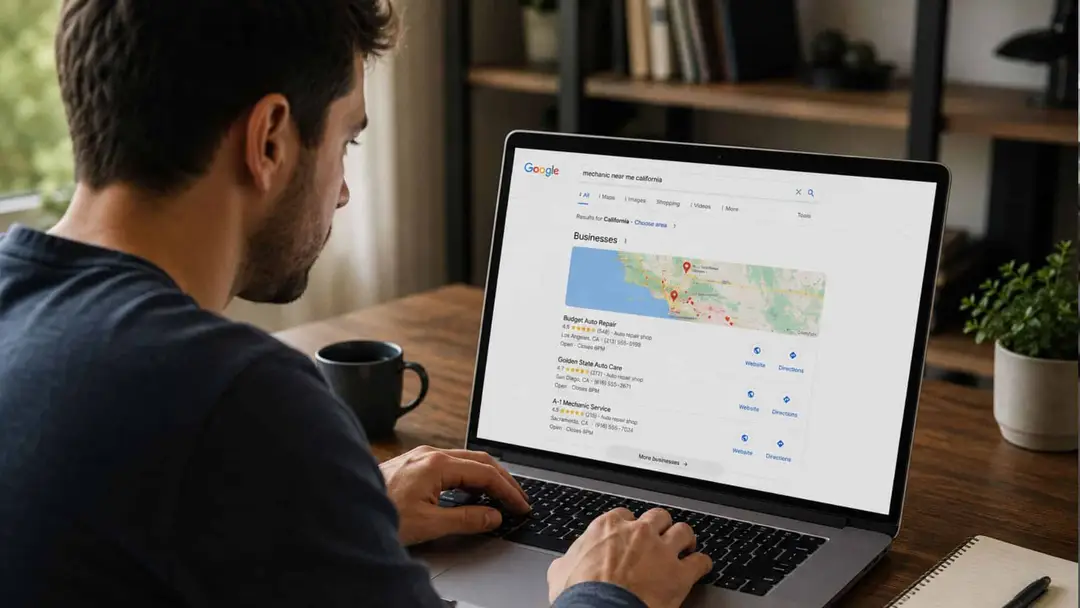
How to get your auto repair shop into the Google Maps local pack, in the order the ranking actually responds to.
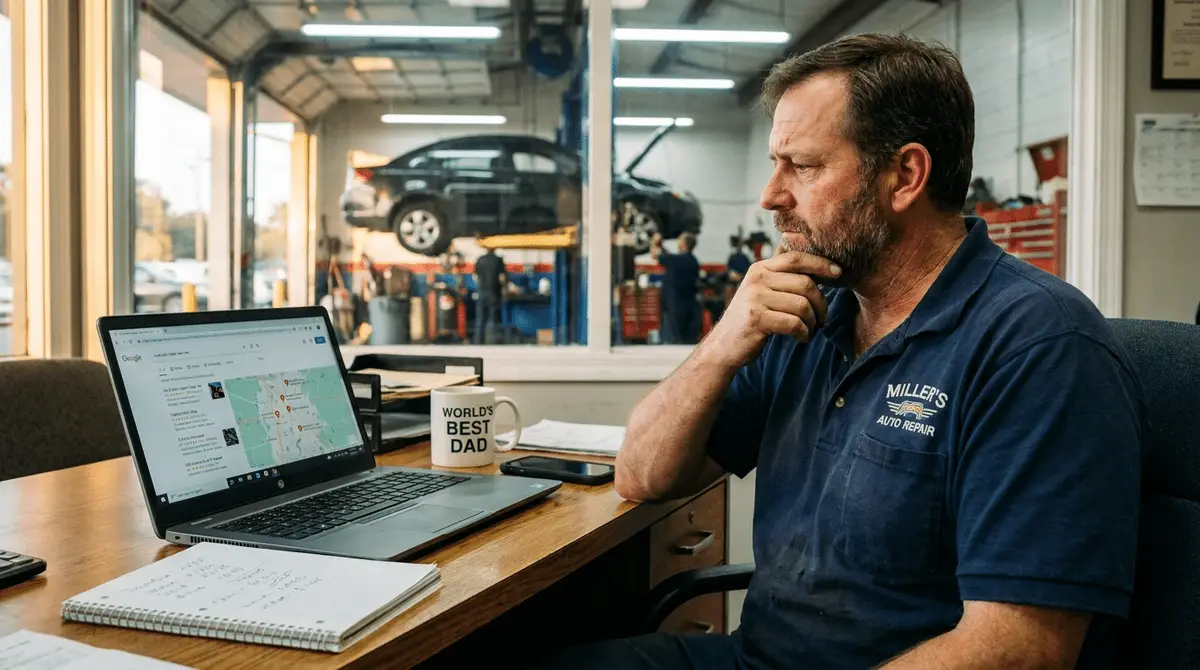
A shop owner types his own city into Google. He scrolls past the ads, past the map, past the three shops Google decided to feature, and finds his own listing on page two next to a tire chain he beats on quality every day of the week. He closes the tab and asks the same question every owner asks at some point: how do I get into that 3-pack? Because below it, he is invisible.
He is right to be annoyed. The Google 3-pack, that little box with the map and three businesses pinned to it, eats most of the local search clicks before anyone scrolls. If a driver in your service area types "mechanic near me" or "brake repair Riverside" or "oil change open Saturday," the three businesses in that box get the call. The shops below them get the leftovers. The shops on page two get a wave from across the parking lot.
So let's run the diagnostic the way you'd run it on a hard-starting truck. We are not going to chase symptoms. We are going to check the systems Google actually uses to rank a local business, in the order they respond, and tell you which lever to pull first. By the end you will know exactly what is keeping you out of the 3-pack and what it takes to break
How Google Picks the Three Shops in the Box
Google has been transparent about the three factors that drive local pack rankings. They are not a mystery. They are just rarely worked in the right order.
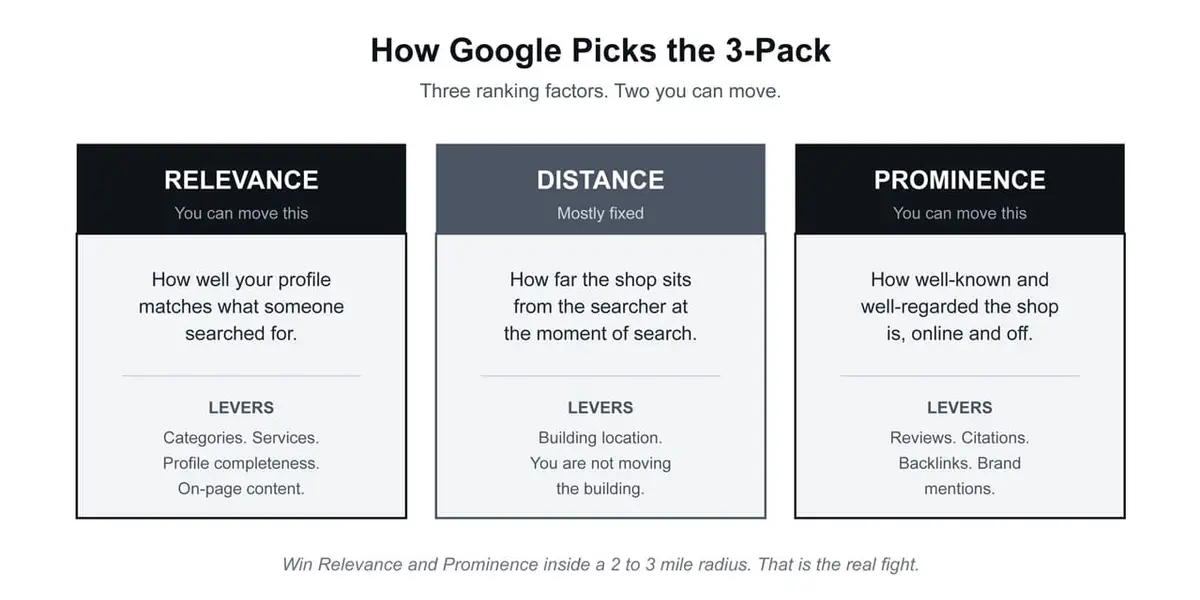
Distance is mostly fixed. You are not moving the building. So the real game is Relevance and Prominence, because those are the two factors you can move with work this quarter. The shops that win the 3-pack are not the closest. They are the ones whose Relevance and Prominence are strong enough to overcome the small distance disadvantage between them and the next shop over.
The first read: you do not need to outrank every shop in your city. You need to outrank every shop within roughly a two to three mile radius of where your typical customer searches from. That is a much smaller fight. Winning that smaller fight is the whole job of local SEO for an auto repair shop. The two levers underneath it are how to get more Google reviews for your auto repair shop and a profile that is not split across two listings, which is covered in adding a second unit to your Google Business Profile.
The Engine Has Five Major Subsystems. Work Them In This Order.
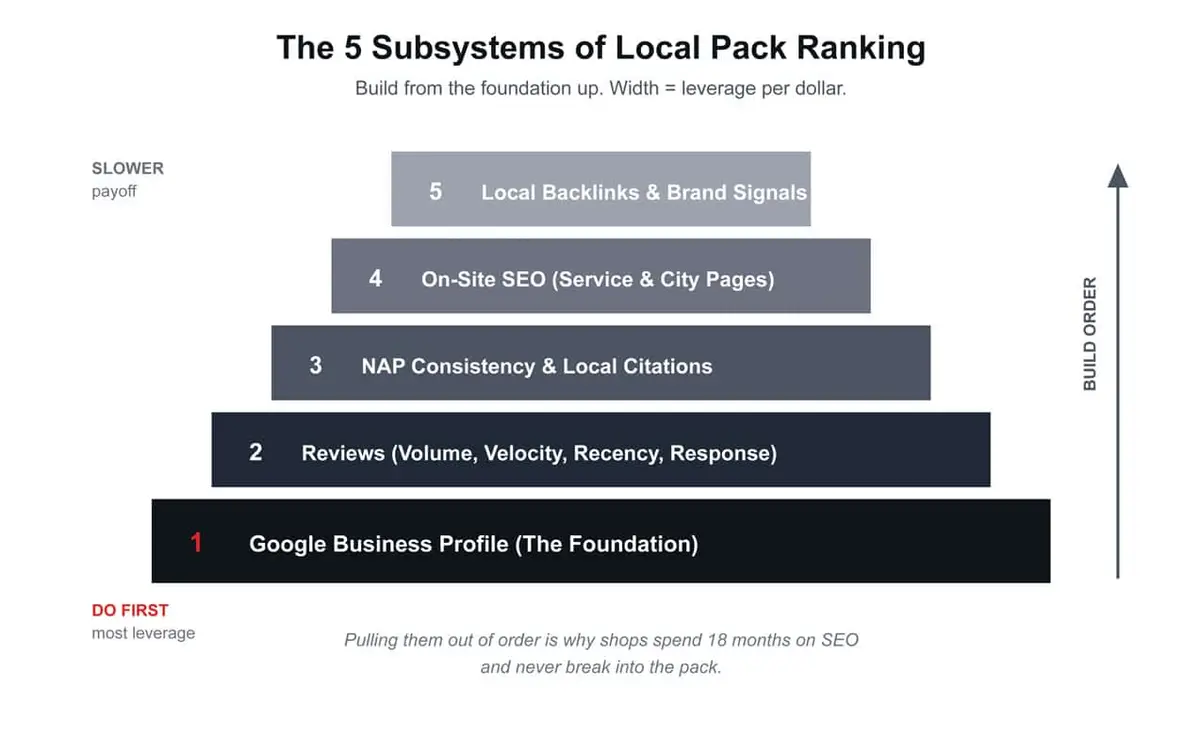
There are dozens of ranking signals Google considers for the local pack. Most "ultimate guides" list them all and let you sort through it. That is not useful. The signals are not equal, and they do not respond at the same speed. Here is the order they actually move the needle in, from the most leverage per dollar to the least.
1. Google Business Profile, treated like your storefront, not your business card
Your GBP is not a directory listing. It is your showroom on the digital street, and it is the single most load-bearing asset in local SEO. The 3-pack is pulled from Google Business Profile data first and the website second. So everything starts here.
A fully optimized GBP for an auto repair shop has, at minimum:
Primary category set to "Auto Repair Shop" (not "Mechanic," not "Car Service"). Wrong primary category is the single most common reason a real shop ranks below a clearly weaker one nearby. Check yours. Most owners discover the agency that "set it up" picked the wrong one.
Every relevant secondary category added. Brake Shop, Oil Change Service, Transmission Shop, Smog Inspection Station, Auto Tune Up Service, whichever apply. These are how you appear in searches that are not your primary service.
Services list fully populated with the specific services you offer, each with a short description that uses the words customers actually type. "Brake pad replacement" is a search. "Brakes" is a category.
Business hours that match reality, including holiday hours. Inaccurate hours tank conversion and Google's confidence in your data at the same time.
A complete description that uses your top service keywords and your city, written like a human wrote it, not a robot. To pick those keywords, use this guide to local keyword research for auto repair shops.
Real photos posted weekly. Exterior, interior, bay shots, the team, before and after work. Geo-tagged when possible. Stock photos hurt you. Phone photos beat stock.
Google Posts published weekly. Specials, service spotlights, customer wins. Posts are a low-effort relevance signal most shops never touch.
Q&A seeded with the questions customers actually ask, answered by the business. If you do not seed them, your competitors and random strangers will, and you lose control of what shows.
This is the work that wins or loses the 3-pack. We have watched a single, anonymized Southern California RV service operation move from a few hundred map views a month to north of seventeen thousand in one optimization cycle, without changing the website at all. That is what a fully built GBP does when the rest of the market is running a half-built one.
The honest version: most shops have a claimed GBP. Very few have an optimized one. The difference is the entire 3-pack. If an old vendor still controls yours, start with how to add a manager to your Google Business Profile.
2. Reviews, by volume, velocity, recency, and response rate
Reviews are the heaviest single Prominence signal in local search. The industry research is stark. A 2025 analysis of 2,260 auto repair Google Business Profiles found that shops ranking in Position 1 had an average of around 2,195 reviews, while shops at Position 10 averaged around 1,885. The gap between winning and losing is review volume, plus the things that travel with it.
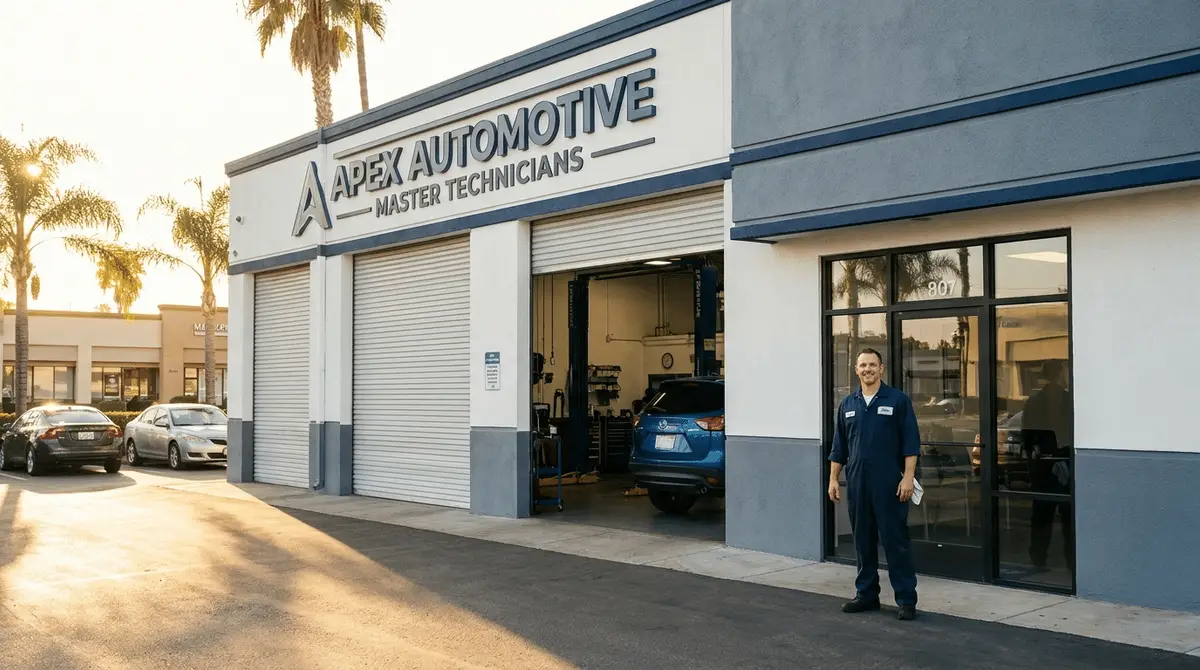
Build the engine that produces all four. Ask in person at checkout. Send an automated SMS with the review link within two hours of job completion, while the experience is still warm. Put a QR code on every receipt and one inside each bay. Respond to every review, good or bad, within 24 hours. Do not offer discounts for reviews. It violates Google's terms and Google is better at catching it than most shop owners think.
A simple way to think about it: if your nearest 3-pack competitor has 220 reviews and you have 47, you are not going to outrank them with a better website. You are going to outrank them by closing that gap over the next two quarters, and by replying to every review they ignore.
3. NAP consistency and local citations
NAP stands for Name, Address, Phone. Across every directory Google trusts, your NAP needs to match exactly. Same business name, same address format, same phone number. When Google sees the same data on Yelp, Bing Places, Apple Maps, the Better Business Bureau, RepairPal, AutoMD, YellowPages, and forty other directories, its confidence in your data goes up, and confident data ranks higher.
Most shops have a NAP problem they do not know about. The shop moved in 2019 and one directory still has the old address. The phone number changed and three directories still have the old one. The legal name is on one listing, the doing-business-as is on another. Every mismatch is a small subtraction from your local prominence.
Run a citation audit. Fix the mismatches. Add your shop to the auto-specific directories most shops ignore (RepairPal, AAA-approved network if you qualify, CarTalk Mechanics Files, AutoMD, BBB). This is grind work, not glamorous, and that is exactly why it is undervalued.
4. On-site SEO that supports the GBP, not the other way around
Most auto repair websites are a leak in three ways. One thin services page. One generic location footer. Zero pages built for the city or neighborhood the shop actually serves. Google reads your website to decide whether your GBP is telling the truth. A site that confirms the GBP's relevance strengthens the 3-pack rank. A site that ignores it weakens it.
What good on-site SEO looks like for a local auto repair shop:
One page per major service. Brakes, oil change, transmission, AC repair, check engine light, smog, tires, diagnostics. Each page real, each page written for the customer searching that specific service.
City and neighborhood pages where they make sense. Not 200 doorway pages for every zip code, that is spam, but real pages for the two or three communities you actively serve, with content that reflects the actual driving in that area.
Local schema markup on the homepage and contact page. Tells Google explicitly what your business is, where it is, and what it does.
Internal links from blog posts to the service pages, and from service pages to the GBP.
Embedded Google Map on the contact page, pointing to your GBP.
You are not trying to outwrite a national tire chain. You are trying to be the most obviously local, most obviously relevant shop in a two to three mile radius. That is a much smaller bar than a generic SEO contractor will quote you for.
5. Local backlinks and brand signals
The last subsystem is the slowest. Other websites linking to yours, especially local ones, are a long-term Prominence signal. The chamber of commerce site, a sponsored local Little League team, the body shop down the street you refer brake work to, the parts supplier with a "where to get it serviced" page. None of these move the needle this week. All of them compound over a year.
Real brand search is the deeper version of this. When people search your shop name by itself, Google reads that as Prominence. Every off-platform marketing channel you run, your social posts, your truck wrap, your community sponsorships, your direct mail, is a brand search generator. They look like brand work. They are also SEO work, even though no SEO agency will quote them on the invoice.
The order is not optional. GBP first. Reviews engine second. Citations third. On-site SEO fourth. Backlinks and brand signals fifth. Pulling them out of order is the most common reason shops spend eighteen months on SEO and never break into the 3-pack.
What "Mechanic Near Me" Actually Means to Google

Here is the part most guides skip. "Mechanic near me" is not really one search. It is hundreds of variations of the same intent, and your job is to be relevant to the cluster, not the exact phrase.
When a driver types "mechanic near me," Google interprets the location automatically. Your GBP does not need to contain the word "near me." It needs to be the most relevant Auto Repair Shop within the small radius around that driver's phone at that moment. Same goes for the cousins: "auto repair near me," "car repair near me," "shop near me," "best mechanic near me," "mechanic open now near me." All the same Relevance + Distance + Prominence calculation, with the search words filtered through the categories and services you set up in step one.
This is why the work above is the work. There is no special "near me" tactic. There is just being the local pack winner, and the local pack winners are the shops whose GBP, reviews, citations, on-site content, and brand signals all point at the same answer at the same time.
The Math, the Way a Shop Owner Runs It

Now price the work against the reward. The 3-pack is where the clicks live. Research consistently shows the top three local pack listings capture the majority of clicks for local intent searches, with the rest of page one fighting over what's left. Below the 3-pack, click rates fall off a cliff.
Run your numbers. Say your shop's average repair order is $450 with roughly a 50 percent gross margin, so $225 gross profit per RO. The local pack delivers an extra 15 to 30 calls a month, conservatively, for an established shop that moves from outside the 3-pack to inside it. At a 40 percent call-to-booking rate, that is six to twelve incremental ROs, or roughly $1,350 to $2,700 in extra gross profit every month, every month, with the channel still compounding.
The compounding part is the point. Once you are in the 3-pack, the work that put you there keeps working. The reviews keep coming in on the system you built. The GBP stays optimized. The citations stay clean. Unlike paid ads, you do not pay to ride in the box. You pay to build the engine, and then the engine produces.
We have watched an anonymized Inland Empire European auto repair shop ride this exact build into the pack and stay there, with cost per lead collapsing from the high double digits to the mid teens once the GBP was carrying the weight the website used to. That is not a discount. That is the channel earning its keep.
What to Do This Week, in Order
If you can give this one diagnostic afternoon, do it in this order:
- Open your Google Business Profile in another tab. Check the primary category. If it is anything other than "Auto Repair Shop," that is your first fix.
- Audit your last 90 days of reviews. Count them. Then look at your nearest 3-pack competitor and count theirs. The gap is your project.
- Search your shop's name plus city. Look at the first ten directory listings that come back. Note every one with a wrong address, old phone number, or misspelled business name. That is your citation cleanup list.
- Look at your website. Count the pages built for individual services. If it is one or zero, you have an on-site problem that is suppressing the GBP.
- Search "mechanic near me" from your shop's parking lot. See who is in the 3-pack. Those are the three shops to study, not the chains in the ads, not the dealerships ranking on brand alone.
That is the work. It is unglamorous. It is also exactly why most shops never do it, and exactly why the shops that do, win the box and hold it.
If you want a faster read on which of the five subsystems is leaking on your shop specifically, book a free Shop Audit and we will show you, line by line, where your profile is losing the pack to a competitor that should not be beating you. No admin access required. We just look at what the rest of the internet sees, and tell you what to fix first.