

How to Rank in the Google 3-Pack for “Mechanic Near Me”

How to Rank in the Google 3-Pack for “Mechanic Near Me”

How to get your auto repair shop into the Google Maps local pack, in the order the ranking actually responds to.

A shop owner types his own city into Google. He scrolls past the ads, past the map, past the three shops Google decided to feature, and finds his own listing on page two next to a tire chain he beats on quality every day of the week. He closes the tab and asks the same question every owner asks at some point: how do I get into that 3-pack? Because below it, he is invisible.

He is right to be annoyed. The Google 3-pack, that little box with the map and three businesses pinned to it, eats most of the local search clicks before anyone scrolls. If a driver in your service area types "mechanic near me" or "brake repair Riverside" or "oil change open Saturday," the three businesses in that box get the call. The shops below them get the leftovers. The shops on page two get a wave from across the parking lot.

So let's run the diagnostic the way you'd run it on a hard-starting truck. We are not going to chase symptoms. We are going to check the systems Google actually uses to rank a local business, in the order they respond, and tell you which lever to pull first. By the end you will know exactly what is keeping you out of the 3-pack and what it takes to break

How Google Picks the Three Shops in the Box

Google has been transparent about the three factors that drive local pack rankings. They are not a mystery. They are just rarely worked in the right order.

google-3pack-ranking-factors

Distance is mostly fixed. You are not moving the building. So the real game is Relevance and Prominence, because those are the two factors you can move with work this quarter. The shops that win the 3-pack are not the closest. They are the ones whose Relevance and Prominence are strong enough to overcome the small distance disadvantage between them and the next shop over.

The first read: you do not need to outrank every shop in your city. You need to outrank every shop within roughly a two to three mile radius of where your typical customer searches from. That is a much smaller fight. Winning that smaller fight is the whole job of local SEO for an auto repair shop. The two levers underneath it are how to get more Google reviews for your auto repair shop and a profile that is not split across two listings, which is covered in adding a second unit to your Google Business Profile.

The Engine Has Five Major Subsystems. Work Them In This Order.

There are dozens of ranking signals Google considers for the local pack. Most "ultimate guides" list them all and let you sort through it. That is not useful. The signals are not equal, and they do not respond at the same speed. Here is the order they actually move the needle in, from the most leverage per dollar to the least.

local-seo-subsystems-build-order

1. Google Business Profile, treated like your storefront, not your business card

1. GOOGLE BUSINESS PROFILE, TREATED LIKE YOUR STOREFRONT, NOT YOUR BUSINESS CARD

Your GBP is not a directory listing. It is your showroom on the digital street, and it is the single most load-bearing asset in local SEO. The 3-pack is pulled from Google Business Profile data first and the website second. So everything starts here.

A fully optimized GBP for an auto repair shop has, at minimum:

$

Primary category set to "Auto Repair Shop" (not "Mechanic," not "Car Service"). Wrong primary category is the single most common reason a real shop ranks below a clearly weaker one nearby. Check yours. Most owners discover the agency that "set it up" picked the wrong one.

$

Every relevant secondary category added. Brake Shop, Oil Change Service, Transmission Shop, Smog Inspection Station, Auto Tune Up Service, whichever apply. These are how you appear in searches that are not your primary service.

$

Services list fully populated with the specific services you offer, each with a short description that uses the words customers actually type. "Brake pad replacement" is a search. "Brakes" is a category.

$

Business hours that match reality, including holiday hours. Inaccurate hours tank conversion and Google's confidence in your data at the same time.

$

A complete description that uses your top service keywords and your city, written like a human wrote it, not a robot.

$

Real photos posted weekly. Exterior, interior, bay shots, the team, before and after work. Geo-tagged when possible. Stock photos hurt you. Phone photos beat stock.

$

Google Posts published weekly. Specials, service spotlights, customer wins. Posts are a low-effort relevance signal most shops never touch.

$

Q&A seeded with the questions customers actually ask, answered by the business. If you do not seed them, your competitors and random strangers will, and you lose control of what shows.

This is the work that wins or loses the 3-pack. We have watched a single, anonymized Southern California RV service operation move from a few hundred map views a month to north of seventeen thousand in one optimization cycle, without changing the website at all. That is what a fully built GBP does when the rest of the market is running a half-built one.

The honest version: most shops have a claimed GBP. Very few have an optimized one. The difference is the entire 3-pack.

2. Reviews, by volume, velocity, recency, and response rate

Reviews are the heaviest single Prominence signal in local search. The industry research is stark. A 2025 analysis of 2,260 auto repair Google Business Profiles found that shops ranking in Position 1 had an average of around 2,195 reviews, while shops at Position 10 averaged around 1,885. The gap between winning and losing is review volume, plus the things that travel with it.

2. REVIEWS, BY VOLUME, VELOCITY, RECENCY, AND RESPONSE RATE

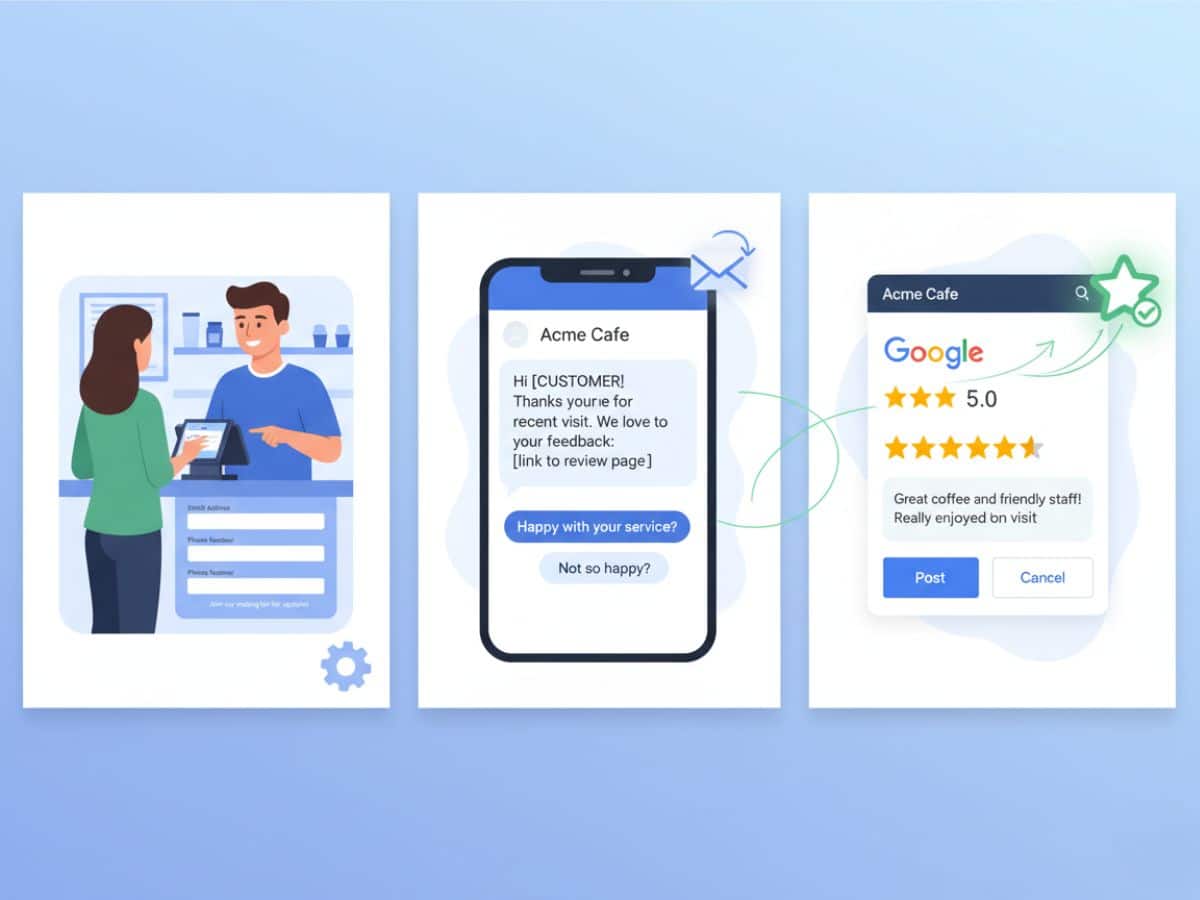
Build the engine that produces all four. Ask in person at checkout. Send an automated SMS with the review link within two hours of job completion, while the experience is still warm. Put a QR code on every receipt and one inside each bay. Respond to every review, good or bad, within 24 hours. Do not offer discounts for reviews. It violates Google's terms and Google is better at catching it than most shop owners think.

A simple way to think about it: if your nearest 3-pack competitor has 220 reviews and you have 47, you are not going to outrank them with a better website. You are going to outrank them by closing that gap over the next two quarters, and by replying to every review they ignore.

3. NAP consistency and local citations

3. NAP CONSISTENCY AND LOCAL CITATIONS

NAP stands for Name, Address, Phone. Across every directory Google trusts, your NAP needs to match exactly. Same business name, same address format, same phone number. When Google sees the same data on Yelp, Bing Places, Apple Maps, the Better Business Bureau, RepairPal, AutoMD, YellowPages, and forty other directories, its confidence in your data goes up, and confident data ranks higher.

Most shops have a NAP problem they do not know about. The shop moved in 2019 and one directory still has the old address. The phone number changed and three directories still have the old one. The legal name is on one listing, the doing-business-as is on another. Every mismatch is a small subtraction from your local prominence.

Run a citation audit. Fix the mismatches. Add your shop to the auto-specific directories most shops ignore (RepairPal, AAA-approved network if you qualify, CarTalk Mechanics Files, AutoMD, BBB). This is grind work, not glamorous, and that is exactly why it is undervalued.

4. On-site SEO that supports the GBP, not the other way around

4. ON-SITE SEO THAT SUPPORTS THE GBP, NOT THE OTHER WAY AROUND

Most auto repair websites are a leak in three ways. One thin services page. One generic location footer. Zero pages built for the city or neighborhood the shop actually serves. Google reads your website to decide whether your GBP is telling the truth. A site that confirms the GBP's relevance strengthens the 3-pack rank. A site that ignores it weakens it.

What good on-site SEO looks like for a local auto repair shop:

$

One page per major service. Brakes, oil change, transmission, AC repair, check engine light, smog, tires, diagnostics. Each page real, each page written for the customer searching that specific service.

$

City and neighborhood pages where they make sense. Not 200 doorway pages for every zip code, that is spam, but real pages for the two or three communities you actively serve, with content that reflects the actual driving in that area.

$

Local schema markup on the homepage and contact page. Tells Google explicitly what your business is, where it is, and what it does.

$

Internal links from blog posts to the service pages, and from service pages to the GBP.

$

Embedded Google Map on the contact page, pointing to your GBP.

You are not trying to outwrite a national tire chain. You are trying to be the most obviously local, most obviously relevant shop in a two to three mile radius. That is a much smaller bar than a generic SEO contractor will quote you for.

5. Local backlinks and brand signals

5. Local backlinks and brand signals

The last subsystem is the slowest. Other websites linking to yours, especially local ones, are a long-term Prominence signal. The chamber of commerce site, a sponsored local Little League team, the body shop down the street you refer brake work to, the parts supplier with a "where to get it serviced" page. None of these move the needle this week. All of them compound over a year.

Real brand search is the deeper version of this. When people search your shop name by itself, Google reads that as Prominence. Every off-platform marketing channel you run, your social posts, your truck wrap, your community sponsorships, your direct mail, is a brand search generator. They look like brand work. They are also SEO work, even though no SEO agency will quote them on the invoice.

The order is not optional. GBP first. Reviews engine second. Citations third. On-site SEO fourth. Backlinks and brand signals fifth. Pulling them out of order is the most common reason shops spend eighteen months on SEO and never break into the 3-pack.

What "Mechanic Near Me" Actually Means to Google

WHAT MECHANIC NEAR ME ACTUALLY MEANS TO GOOGLE

Here is the part most guides skip. "Mechanic near me" is not really one search. It is hundreds of variations of the same intent, and your job is to be relevant to the cluster, not the exact phrase.

When a driver types "mechanic near me," Google interprets the location automatically. Your GBP does not need to contain the word "near me." It needs to be the most relevant Auto Repair Shop within the small radius around that driver's phone at that moment. Same goes for the cousins: "auto repair near me," "car repair near me," "shop near me," "best mechanic near me," "mechanic open now near me." All the same Relevance + Distance + Prominence calculation, with the search words filtered through the categories and services you set up in step one.

This is why the work above is the work. There is no special "near me" tactic. There is just being the local pack winner, and the local pack winners are the shops whose GBP, reviews, citations, on-site content, and brand signals all point at the same answer at the same time.

The Math, the Way a Shop Owner Runs It

The Math, the Way a Shop Owner Runs It

Now price the work against the reward. The 3-pack is where the clicks live. Research consistently shows the top three local pack listings capture the majority of clicks for local intent searches, with the rest of page one fighting over what's left. Below the 3-pack, click rates fall off a cliff.

Run your numbers. Say your shop's average repair order is $450 with roughly a 50 percent gross margin, so $225 gross profit per RO. The local pack delivers an extra 15 to 30 calls a month, conservatively, for an established shop that moves from outside the 3-pack to inside it. At a 40 percent call-to-booking rate, that is six to twelve incremental ROs, or roughly $1,350 to $2,700 in extra gross profit every month, every month, with the channel still compounding.

The compounding part is the point. Once you are in the 3-pack, the work that put you there keeps working. The reviews keep coming in on the system you built. The GBP stays optimized. The citations stay clean. Unlike paid ads, you do not pay to ride in the box. You pay to build the engine, and then the engine produces.

We have watched an anonymized Inland Empire European auto repair shop ride this exact build into the pack and stay there, with cost per lead collapsing from the high double digits to the mid teens once the GBP was carrying the weight the website used to. That is not a discount. That is the channel earning its keep.

What to Do This Week, in Order

If you can give this one diagnostic afternoon, do it in this order:

  1. Open your Google Business Profile in another tab. Check the primary category. If it is anything other than "Auto Repair Shop," that is your first fix.
  2. Audit your last 90 days of reviews. Count them. Then look at your nearest 3-pack competitor and count theirs. The gap is your project.
  3. Search your shop's name plus city. Look at the first ten directory listings that come back. Note every one with a wrong address, old phone number, or misspelled business name. That is your citation cleanup list.
  4. Look at your website. Count the pages built for individual services. If it is one or zero, you have an on-site problem that is suppressing the GBP.
  5. Search "mechanic near me" from your shop's parking lot. See who is in the 3-pack. Those are the three shops to study, not the chains in the ads, not the dealerships ranking on brand alone.

That is the work. It is unglamorous. It is also exactly why most shops never do it, and exactly why the shops that do, win the box and hold it.

If you want a faster read on which of the five subsystems is leaking on your shop specifically, the GBP Leak Report runs the diagnostic and shows you, line by line, where your profile is losing the pack to a competitor that should not be beating you. No admin access required. We just look at what the rest of the internet sees, and tell you what to fix first.

Are Google Ads Worth Running for an Auto Repair Shop, and How Much Should You Budget?

Are Google Ads Worth Running for an Auto Repair Shop, and How Much Should You Budget?

An auto shop owner's playbook for deciding whether to fund Google Ads, how much to spend, and how to keep the channel from burning at the intake.

A shop owner gets the same call three weeks in a row. Different reps, same pitch. "We can have you on page one tomorrow." He has already tried two of these vendors.

The first one ran a $1,200 a month campaign for six months and produced what looked like clicks and almost no booked work.

The second one quoted him $2,500 and asked him to sign a twelve-month agreement before showing a single number. He has a feeling Google Ads can work for an auto repair shop. He has not yet seen it work for his shop.

So the question sitting on his desk is the same question every owner asks at this stage: are Google Ads actually worth it for a shop like mine, and if they are, how much do I budget without setting the money on fire?

That is the right question. And the honest answer has nothing to do with a fixed percentage of revenue. It has to do with whether your shop has the three things Google Ads needs to compound, and whether the budget is calculated from a car count target or guessed from a benchmark someone read on a blog.

So let's run the diagnostic the way you would run it on a check engine light. We are going to check the systems that have to be working before the channel is worth funding, lay out the math the way a shop owner actually runs it, and tell you when Google Ads earn their keep and when they leak fuel out the bottom of the tank.

When Google Ads Are Worth It, and When They Are Not

Google Ads is the fastest paid path to a phone ringing in your service bay. That part is real.

A driver types "brake repair near me" or "check engine light Riverside" and a click costs you somewhere between $3 and $15 in most US auto repair markets, with the higher end showing up in dense urban competition and the lower end in smaller markets, per Tread Partners' 2025 analysis.

The traffic exists. The intent is high. The question is whether your shop is built to convert it once it arrives.

Here is the part most owners skip past. Paid traffic is fuel. Fuel does not move a vehicle unless the engine is built and the transmission is connected.

If a click lands on a generic homepage with a slow load time, no clear phone number above the fold, no service-specific page for the search that triggered the ad, and a front desk that lets it go to voicemail at 2:14 on a Tuesday afternoon, the budget is funding a leak, not a campaign.

google ads three questions

The shops where Google Ads work, work because three things are true at the same time:

1. The shop knows exactly how many incremental cars it needs the channel to produce. Not a vague "more leads." A number. Twelve booked ROs a month. Twenty. Eight on a Tuesday before the rest of the week fills.
2. The conversion path is built. A service-specific landing page that matches the ad, a phone number that gets answered by a trained service writer inside three rings, a form that submits to a CRM that pings a human in under five minutes.
3. The tracking is in place before any spend goes live. Call tracking, form tracking, conversion events back to Google, CRM tagging so the booked RO is tied back to the original click. Without it, Google optimizes for clicks because that is the only signal it can see. With it, Google optimizes for the customers you actually want.

A shop missing any one of those three is not ready to fund Google Ads. It is ready to fund the work that makes Google Ads worth funding. That is a different month of the build, and a different invoice.

The first read: Google Ads is not a marketing channel you bolt onto a broken shop. It is a throttle you press once the rest of the engine is producing torque on its own. Press it first and you spin the wheels in neutral. The slower, compounding side of the same question is what auto repair SEO costs and whether it is worth it. We run the paid side of the engine as Google Ads management for auto repair shops.

Why the "Percentage of Revenue" Benchmark Misleads Most Shops

Why the Percentage of Revenue Benchmark Misleads Most Shops

The benchmark you have seen quoted everywhere, including Shop Dog Marketing and Tread Partners, is 4 to 5 percent of annual revenue for an established shop, up to 10 percent for a brand new one. Those numbers are not wrong. They are also the wrong place to start.

Here is why. A shop doing $1.2 million in annual revenue at 5 percent is supposed to spend $60,000 a year, or $5,000 a month, on marketing. Fine. But that $5,000 is the marketing total, not the Google Ads line item.

Most owners read "marketing budget" and hear "ad budget," then pour the full envelope into Google Ads, starving every other channel in the pipeline. Reviews stall. The website stays generic. The GBP sits half-built. The follow-up sequence does not exist. The ads run alone, which is the most expensive way to run them.

The percentage is a ceiling check, not a plan. It tells you whether you can afford to do the full marketing build. It does not tell you how much Google Ads should be inside that envelope. That number gets calculated differently.

The Math, the Way a Shop Owner Actually Runs It

Run the budget backward from the outcome, not forward from a percentage. This is the math that survives a board meeting and a Saturday morning at the front counter both.

Start with the car count target. How many incremental ROs do you need Google Ads, specifically, to produce per month? Not your total car count, not your organic and referral cars. Just the ones you are asking the paid channel to deliver. Call it twenty for an established shop that already has organic traffic working. Call it eight to twelve for a smaller operation testing the channel for the first time.

Then layer in the funnel math:

$

Lead to booked RO. A trained service writer answering a tracked phone number books somewhere between 35 and 55 percent of inbound calls into actual ROs, with the variance driven almost entirely by call handling, not by ad copy. Take the middle: 45 percent.

$

Click to lead. A well-built service-specific landing page with a phone number above the fold, real shop photos, and a short trust line converts somewhere between 8 and 15 percent of clicks into calls or form fills. Take the middle: 11 percent.

$

Local cost per click. Auto repair CPCs run $3 to $15 depending on market density, per the 2025 industry research. Pick the right number for your market by running a Google Keyword Planner check on your top five service searches. For most independent shops outside the densest metros, $6 to $9 is a realistic working number.

Plug it in. Twenty incremental ROs per month, at 45 percent close, is roughly 45 leads needed. Forty-five leads at an 11 percent click conversion is about 410 clicks needed. Four hundred ten clicks at $8 per click is roughly $3,300 in monthly Google Ads spend.

Now check the result against your gross profit per RO to see if the math earns its keep. Say your average repair order is $480 with a 50 percent gross margin, so $240 gross profit per RO. Twenty incremental ROs is $4,800 a month in gross profit against $3,300 in ad spend, which is a positive but tight margin in month one and a meaningfully better one by month six as the campaign learns and quality score improves.

The honest version: if the math does not pencil at month one with conservative assumptions, do not run Google Ads. Build the rest of the system first, then revisit. A budget calculated from a car count target keeps you honest. A budget set as "whatever 5 percent of revenue works out to" lets you fund a leak for six months without knowing it.

What Compounds When the Channel Is Built Inside a Real System

The reason most "Google Ads is a waste" posts on Reddit and Facebook groups exist is not because Google Ads is a waste. It is because the channel was run as a standalone tactic instead of one component inside a larger marketing chassis. Run it that way and the cost per lead stays flat or climbs. Run it inside a built system, and the cost per lead compounds downward.

cpl compounding curve

A Southern California RV service and paint operation we worked with started paid advertising, with a cost per lead sitting around $80. That number is not unusual for a paid campaign running in isolation on a niche service in a competitive market. What is unusual is what happened next.

Over the same build cycle, the GBP was fully optimized, service-specific landing pages were built for each of the top revenue services, call tracking and conversion events were wired into Google Ads, and the existing customer database was activated with a real follow-up sequence.

The paid ads were one piece of that work, not the whole work. By the end of the cycle, the cost per lead had settled around $16. Monthly lead volume increased from roughly 10 leads per month to 147. GBP map views grew by a factor of 51 over the same period.

The ads did not get cheaper because the bid strategy got smarter. The ads got cheaper because the rest of the pipeline started carrying weight the ads used to carry alone. Google's quality score rewards landing pages that match the ad and convert visitors. Conversion tracking allows the algorithm to optimize for booked ROs instead of clicks. A booked customer leaving a review compounds the GBP, which lifts organic traffic, meaning a smaller share of demand has to be bought through ads at all.

That is what "compounding" actually looks like on a marketing line item. The channel earns its keep not because the budget got smaller, but because every dollar inside the budget started doing more work.

What Most Shops Get Wrong, and Why the Money Disappears

What Most Shops Get Wrong, and Why the Money Disappears

A few patterns show up almost every time a shop tells us Google Ads "did not work." None of them are about the ads platform itself. All of them are about what surrounds the ads.

$

The campaign was set up with broad match keywords and no negative keyword list. Broad match is Google's default, and it will spend your budget on searches like "Google Ads for auto repair" or "how to fix my own brakes" or "free oil change near me" within a week if nothing stops it. A negative keyword list of 50 to 200 terms, built and maintained monthly, is not optional. It is the seal that keeps the wrong fuel out of the line.

$

The ad goes to the homepage, not a service-specific landing page. A click on "transmission repair Riverside" that lands on a generic homepage loses about half its converting audience at the door. Each top revenue service needs its own page, written for the search that triggered the ad, with the phone number above the fold and one clear next action.

$

There is no conversion tracking. This is the single most common gap. Without it, the agency reports clicks and impressions because clicks and impressions are the only numbers visible. The shop has no idea what a lead actually costs, no idea what a booked RO actually costs, and no way to tell if the channel is profitable. The dashboard looks fine. The bank account does not.

$

The phone gets answered like a default ringing phone, not a sales line. Every Google Ads call should be answered inside three rings by someone trained to convert. Voicemail kills a paid lead at a cost of $8 to $80 per call, depending on the click that produced it. Recording calls and reviewing five per week is the cheapest optimization move in the entire stack.

$

The shop pulls the budget at month three because "it is not working." Google Ads campaigns need 90 days of clean data to optimize. A shop that cancels at day 75 because the first 30 days were rough never sees what the channel does in month four, five, and six, when the algorithm has finally learned which clicks book ROs. Either commit to the full diagnostic window or do not start.

What to Do This Week, in Order

If you can give this one diagnostic afternoon and one staff meeting, do it in this order before you fund a single click:

1. Write down your incremental car count target. Not your total target. The cars you need Google Ads, specifically, to produce per month for the next 90 days. One number, on paper.
2. Pull your last 30 inbound calls and listen to ten of them at random. Count how many were answered inside three rings. Count how many ended with an appointment booked. That close rate is the multiplier on every paid lead you are about to buy.
3. Open your website and search "transmission repair [your city]," "brake repair [your city]," and "check engine light [your city]" in three browser tabs. If your homepage is the landing page for all three, you have an on-site gap that will eat 30 to 50 percent of every paid click before the budget is even touched.
4. Verify call tracking is in place. If your current Google Ads setup, or any other paid channel, does not have call tracking with a unique number wired to your CRM, no further ad spend should happen until that is fixed.
5. Run the backward math on your shop. Pull your average repair order, your gross margin, and your realistic estimate of the click conversion and call close rates. Calculate the budget the math produces. Compare it to what you are spending now. The gap, in either direction, is the project.

That is the diagnostic. None of it requires Google Ads to be running. All of it determines whether Google Ads should be.

The shops that run paid traffic profitably for years did this work first. The shops that quit after six months and tell their friends "Google Ads is a waste" did not. Same platform, same auction, same CPC range. Different chassis underneath.

If you want a faster read on whether your shop is ready to fund Google Ads, or whether the budget is leaking out somewhere upstream in the conversion path, the GBP Leak Report runs the diagnostic on your shop's full local marketing system and shows you, line by line, where the engine is misfiring. No admin access required. We look at what the rest of the internet sees, what your competitors look like next to you, and what would have to be true for paid traffic to compound instead of burn.

What to Post on Social Media for Your Auto Repair Shop

What to Post on Social Media for Your Auto Repair Shop

An auto shop owners's playbook for how they should be posting without guessing what to post and whether any of it works.

A shop owner sits in his office at 7:14 on a Wednesday night. The bay is closed, the techs are gone, and his phone is open to Instagram.

He has been scrolling for twenty minutes trying to decide what to post. He finally takes a photo of a wheel hub he replaced earlier, types out a caption, deletes it, types it again, posts something that feels lame, and closes the app.

The post gets four likes. Three are from his wife, his sister, and a parts vendor in another state. He tells himself social media is a waste of time and goes home.

Here is the part he is missing. The next morning, three different drivers in his city are sitting at red lights, deciding which shop to call for a brake job.

Each one types his shop name into Instagram or Facebook to see if the place is real. Two of them find a profile that looks abandoned, the last post is from August, the photos are stock images of generic mechanics, and they close the tab.

They call the chain down the street instead. He never sees the leak. He just sees a slow week and blames the economy.

Industry research is blunt about this. Roughly 74 percent of consumers research a local service business on social media before contacting them. An inactive or sloppy profile is not neutral. It is a negative signal, the same way a dirty waiting room and a hand-written "open" sign in the window send a negative signal. The leak is not that he is not running ads. The leak is that the social profiles he already owns are quietly costing him trust every time a buyer checks.

So let's run the diagnostic differently. We are going to define what to post, how often, on which platforms, in what order, so that the time you spend on social actually compounds instead of disappearing. By the end you will have a calendar a busy shop owner can actually run, with no full-time content creator on payroll. Social sits on top of reputation, so if the review count is thin, start with how to get more Google reviews for your auto repair shop and come back to this. Running both together is what we do as social media and reputation management for auto shops.

The Real Reason Social Media Matters for an Auto Repair Shop

It is not about going viral. It is not about reaching new customers cold. It is about the buyer who already heard your name from a friend, a Google search, or a sign on the freeway, and is now checking to see if you exist.

That check is the moment. They are looking at three things, fast, on a phone screen:

$

Is this place real and still in business? Recent posts, recent photos, recent activity.

$

Do humans I would trust work here? Faces, names, the shop dog, the team in branded shirts.

$

Have they done work like mine before? Photos of repairs, vehicles like theirs, problems like the one they are sitting in their driveway worrying about.

If your profile answers those three questions in fifteen seconds, you stay on the call sheet. If it does not, you do not. That is the entire job of social media for an auto repair shop at this stage. Not awareness. Not lead generation. Trust confirmation at the moment of decision. Once you reframe it that way, what to post becomes obvious.

The first read: social media for your shop is not a top-of-funnel lead engine. It is a trust layer that catches the leads other channels deliver. Treat it that way and the content gets easier.

The Four Content Pillars That Actually Work

You do not need 50 content ideas. You need four pillars and a rotation. The shop owners who post consistently for a year all converge on roughly the same mix. It works because it answers the three trust questions on repeat.

1. Before and after repair photos

1. BEFORE AND AFTER REPAIR PHOTOS

This is the highest-converting content an auto repair shop can post. A picture of a rusted, leaking water pump next to the new one installed in the same engine bay. A worn brake rotor next to the fresh one going on. A cracked CV boot next to the rebuilt axle. The work is visually obvious to anyone, even someone who has never opened a hood.

The mechanics of it:

  • Phone photo, taken in the bay, in normal light. No staging. No stock background.
  • One photo of the failed part, one of the fix, both from roughly the same angle.
  • Caption is one to three sentences. What the customer brought it in for, what you found, what you replaced. No jargon dump.
  • Tag the make and model in the caption. People search "BMW brake replacement near me," not "brake job near me."

This pillar alone, posted twice a week, fills more than half your calendar.

2. Short tech explanations on camera

2. SHORT TECH EXPLANATIONS ON CAMERA

A 30 to 60 second clip of a tech holding a part and explaining what they just found. "This is a serpentine belt. This one has cracks every quarter inch. When this breaks, your alternator stops charging and your power steering goes out at the same time. That is why we caught it now." That is the entire script.

This pillar does work no other pillar can do. It puts a face on the shop. It demonstrates competence in the most credible way possible. It teaches the prospect something before they ever spend a dollar. Most shops skip this pillar because the owner thinks the tech will not want to be on camera. Half of them actually love it. Ask.

The bar is low. Vertical phone video. Natural light. Tech in shop uniform. No script memorization. One take. Done in three minutes between cars.

3. Customer wins and testimonials

3. CUSTOMER WINS AND TESTIMONIALS

Borrowed trust is the cheapest trust there is. A 20 second clip of a customer saying "I came in worried it was the transmission, they found it was a sensor, saved me four grand" is worth more than any ad you could write about yourself. The customer is doing the selling for you, and the prospect believes another driver in a way they will never believe the shop.

The mechanics:

  • Ask at checkout, when the customer is happiest. "Mind if we record a quick 20 second video of your experience? Helps independent shops like us stay visible."
  • Vertical phone video. One question prompt. Let them talk. Cut the dead air.
  • Tag the make and model again. Reinforce the relevance signal for prospects searching that vehicle.
  • Repost as static images with a pull-quote when you do not have video, especially for Google reviews you can screenshot.

This pillar takes 90 seconds at the counter and produces content you can post for a month.

4. Behind the bay and team content

4. BEHIND THE BAY AND TEAM CONTENT

This is the pillar most shops skip. It is also the one that builds the brand. A photo of the morning huddle. The shop dog asleep on the customer couch. A new tech on his first day. The team in the parking lot after closing on a Friday. Seasonal stuff. The little human moments that prove a real crew runs the shop and they like it there.

This is the humanity lever. It is what separates your shop from a corporate chain whose social feed reads like it was written by a robot. Posting one of these a week is the lowest-effort, highest-trust move in the entire calendar. Almost nobody does it consistently. The shops that do, build a local brand the chains cannot replicate.

The honest version: most shops post pillar 1 only, never get around to pillars 2 and 3, and treat pillar 4 like it does not exist. That is why their feeds feel mechanical. The fix is not more posts. The fix is rotating all four.

The Platform Priority Stack

Not every platform deserves the same effort. The shops getting real returns from social are picky about where they spend their time, and they build the stack in this order.

platform priority stack

1. Google Business Profile (yes, it is a social platform now)

Most shop owners do not think of GBP as social media. Google does. The Posts feature, the Updates section, the photo gallery, the Q and A, all of it functions like a social feed pinned to the listing buyers see first when they search your shop name or "mechanic near me." A weekly GBP post is the single highest-leverage piece of social content an auto repair shop can publish, and almost no shop does it.

This is the chassis of your social presence. Build it first. Everything else amplifies it. A buyer who searches your name lands on the GBP before they land on Instagram. If the GBP is dead, the rest does not matter.

2. Facebook business page

2. FACEBOOK BUSINESS PAGE

For independent auto repair shops, Facebook is where your actual buyer demographic lives. Drivers 35 to 65, the people who own the cars that need real work, are on Facebook daily. They are on Instagram sometimes. They are on TikTok rarely. Treat Facebook as the load-bearing platform. Post the four pillars there. Cross-post the visual ones to Instagram. Tag your city in every post for the local geo signal.

A Facebook business page that posts three times a week with real shop content outperforms a Facebook page that runs paid ads with stock imagery. The page is the trust layer the ad runs through.

3. Instagram (Reels and Stories first, grid second)

3. INSTAGRAM (REELS AND STORIES FIRST, GRID SECOND)

Instagram is where the visual content compounds. Reels reach further than grid posts right now and will for the foreseeable future. The four pillars all work as Reels. Cross-post from Facebook with one tap, do not duplicate effort.

Stories are the daily pulse. A quick photo of a car coming in, a tech at work, a finished job rolling out, the lobby coffee pot at 7 a.m. Stories disappear in 24 hours, which means the bar is lower. Post six or seven a week. They reinforce the "this shop is alive and operating" signal that the static feed cannot.

4. YouTube Shorts

YouTube Shorts is a free distribution channel for the tech-explanation pillar and the customer-win pillar. The same 30 to 60 second vertical clips you shot for Instagram Reels upload to Shorts in two taps. The reach is bonus, the SEO benefit (Shorts get indexed by Google and appear in local searches for the make and model) is the real prize.

Do not build a separate content engine for Shorts. Just upload what you already shot.

5. TikTok (optional, and only if you can shoot weekly)

5. TIKTOK (OPTIONAL, AND ONLY IF YOU CAN SHOOT WEEKLY)

TikTok is a real platform for shops with a charismatic tech or owner who can hold the camera. If you do not have that person, skip it. The platform punishes inconsistency more than the others, and the demographic skews younger than your typical auto repair buyer. If you have the bandwidth, repurpose the same vertical content from the other platforms here. If you do not, focus your time on platforms 1 through 4 and revisit this in six months.

The order matters because of the fuel split. GBP is the foundation. Facebook is where buyers live. Instagram is where the content compounds. Shorts is free distribution. TikTok is upside. Build top-down and you will burn out. Build bottom-up and the engine produces.

Posting Frequency, the Way a Busy Shop Owner Can Actually Run It

POSTING FREQUENCY, THE WAY A BUSY SHOP OWNER CAN ACTUALLY RUN IT

Three to four posts per week, across all platforms combined, is the floor that works. Not per platform. Total. Distributed roughly like this:

$

Two Facebook posts per week (one before/after, one rotating pillar). Cross-post the visual one to Instagram.

$

One Instagram Reel per week (the tech explanation or the customer win).

$

One Google Business Profile post per week (a special, a service spotlight, a recent win).

$

Five to seven Instagram Stories per week (daily pulse, low effort, phone screenshots of life in the shop).

$

One YouTube Short per week (the Instagram Reel re-uploaded).

That is the entire calendar. Roughly 90 minutes per week of actual content creation if you batch it, plus the Stories which happen in real time on the shop floor. A service writer or front desk staffer can run most of it once the pillars are defined. The owner records the tech-explanation clips and shoots a customer testimonial at checkout when one walks in happy. That is the operating model.

Consistency beats virality. A shop that posts three solid pillar posts a week for 12 months in a row will out-trust a shop that posts daily for a month, disappears for four months, and comes back. The compounding signal is what builds the local brand. The single viral post does not.

The Math, the Way a Shop Owner Runs It

THE MATH, THE WAY A SHOP OWNER RUNS IT

Now run the time-versus-return math on your own units.

Say your shop's average repair order is $450 with a 50 percent gross margin, so $225 gross profit per RO. The social presence is not generating cold leads. It is doing two things:

$

Reducing the percentage of buyers who bounce after checking your profile. Industry data on consumer research behavior in local service categories suggests a meaningful share of buyers, conservatively 10 to 20 percent, skip a business that looks inactive on social. If your shop fields 200 prospect interactions a month from all channels (website visits, GBP impressions, referrals, social), and even half of those buyers check social, recovering a 10 percent bounce rate is roughly 10 incremental booked customers.

$

Increasing the conversion rate of buyers who do check social and like what they see. A profile with active posts, real photos, and visible humans converts at a higher rate than one that looks abandoned. The mechanism is trust, the effect is measurable.

At 10 incremental bookings per month, at $225 gross profit per RO, that is roughly $2,250 in recovered gross profit per month, every month, from a social presence that costs you 90 minutes of attention per week to maintain. Run the math at your numbers. Be honest about your typical RO and your traffic. The case for posting three to four times a week is almost always overwhelming once the numbers are on paper.

The compounding part is the point. Every post you publish this week is still working for you in month 18 when a buyer checks your profile. Unlike paid ads, the content does not disappear when the budget runs out. It is equity, not fuel.

What to Do This Week, in Order

If you can give this one afternoon and one staff meeting, do it in this order:

1. Open your Google Business Profile. Scroll to Posts. If the most recent post is more than 30 days old, write one today. A current special, a recent repair, a holiday hours update. Anything that proves the listing is alive.
2. Open your Facebook business page. Note the date of the last post. If it is more than 14 days old, take three phone photos in your bay tomorrow and post one with a real caption. Do not overthink it.
3. Pick one tech on your crew who would not mind being on camera. Tell them you are going to record one 60 second clip per week of them explaining a real find from a real car. Schedule it for the same time every week so it becomes a habit, not an event.
4. At checkout tomorrow, ask one happy customer for a 20 second video testimonial. Just one. Vertical phone video. If they say yes, you have content for two weeks across three platforms.
5. Block 60 minutes on your calendar every Monday morning for the next six weeks to batch the week's posts. Same hour, same chair, same coffee. Make it a recurring appointment, not a someday-when-I-have-time task. Most shops fail at social because there is no scheduled slot for it. Fix that and the rest follows.

That is the diagnostic. It is unglamorous. It is also exactly why most shops never get traction on social, and exactly why the shops that do build a local trust layer the chains cannot match.

If you want a faster read on which part of your shop's digital trust layer is leaking (the GBP, the Facebook page, the review profile, or the photo gallery a prospect sees first), the GBP Leak Report runs the diagnostic on your shop and shows you where the trust signals are misfiring. No admin access required. We look at what the rest of the internet sees and tell you what to fix first.

How to Get More Google Reviews for Your Auto Repair Shop

How to Get More Google Reviews for Your Auto Repair Shop

A practitioner's playbook for building a review engine that compounds, not a one‑week push that fizzles — and that stays inside Google's 2025–2026 rules.

A shop owner posts in a Facebook group at 9:47 on a Tuesday night. He owns a clean operation, ten years in, sharp techs, the kind of shop where the waiting room smells like coffee instead of stale tires.

His post says: “Only 27 reviews. How do I get more without being annoying?”

The replies roll in. Buy a review‑gen tool. Bribe customers with free oil changes. Print a sign for the counter. Send a text. Two of those tactics violate Google’s terms.

One of them works for about three weeks and then dies. The fourth is most of the answer, but only if the underlying data is clean.

Here is the part nobody tells him. The dealership two miles down the road has 2,000 reviews. The competing shop he beats on quality every single day has 280. He has 27. That gap is not just embarrassing.

It is bleeding leads he is already paying for. Every click that lands on his Google Business Profile, sees 27 reviews, then bounces to the shop with 280, was a lead he paid for in time, brand work, and rent on a good location. The leak is in the conversion step, not the awareness step.

So let’s stop chasing the symptom. We are going to look at what Google actually reads when it weighs reviews, how 2025–2026 policy updates changed the rules on *how* you can ask, and how to build an engine that produces reviews consistently without crossing any lines.

By the end, you will know exactly how to ask, when to ask, what tools to use, what not to do, and where the nuance really sits between “ask at the counter” and “only email later.”

A quick 2026 note on Google’s review policy (and the POS nuance)

A QUICK 2026 NOTE ON GOOGLE’S REVIEW POLICY (AND THE POS NUANCE)

Google’s official review rules live in its Maps user‑generated content policy, its “Prohibited & restricted content” / rating‑manipulation section, and its Business Profile restrictions for policy violations. As of late 2025 and spring 2026, three ideas matter most for an auto repair shop:

$

Google treats rating manipulation as any attempt to directly or indirectly influence star ratings through coercion, incentives, or orchestrated campaigns (for example, heavily pressuring customers or telling them what to say).

$

Reviews must be genuine, voluntary, and based on real experiences — no fake content, no off‑topic rants, no “friend of the owner” reviews. 

$

If Google detects patterns of fake or abusive engagement, it can remove reviews, pause new reviews, or restrict the profile while it cleans things up. 

There is a myth floating around local SEO (and I helped spread a too‑simplistic version of it) that “asking for reviews at point of sale is against Google’s rules.” That is **not** what Google’s documentation actually says. What the rules say is that you **cannot coerce or pressure people, cannot require reviews as part of the checkout, and cannot run manufactured review campaigns**, especially if they produce suspicious on‑premise patterns like lots of reviews from the same device or network.

The nuance:

$

You are allowed to ask for reviews and give customers a link or QR to make it easier — including on receipts and in your waiting room.

$

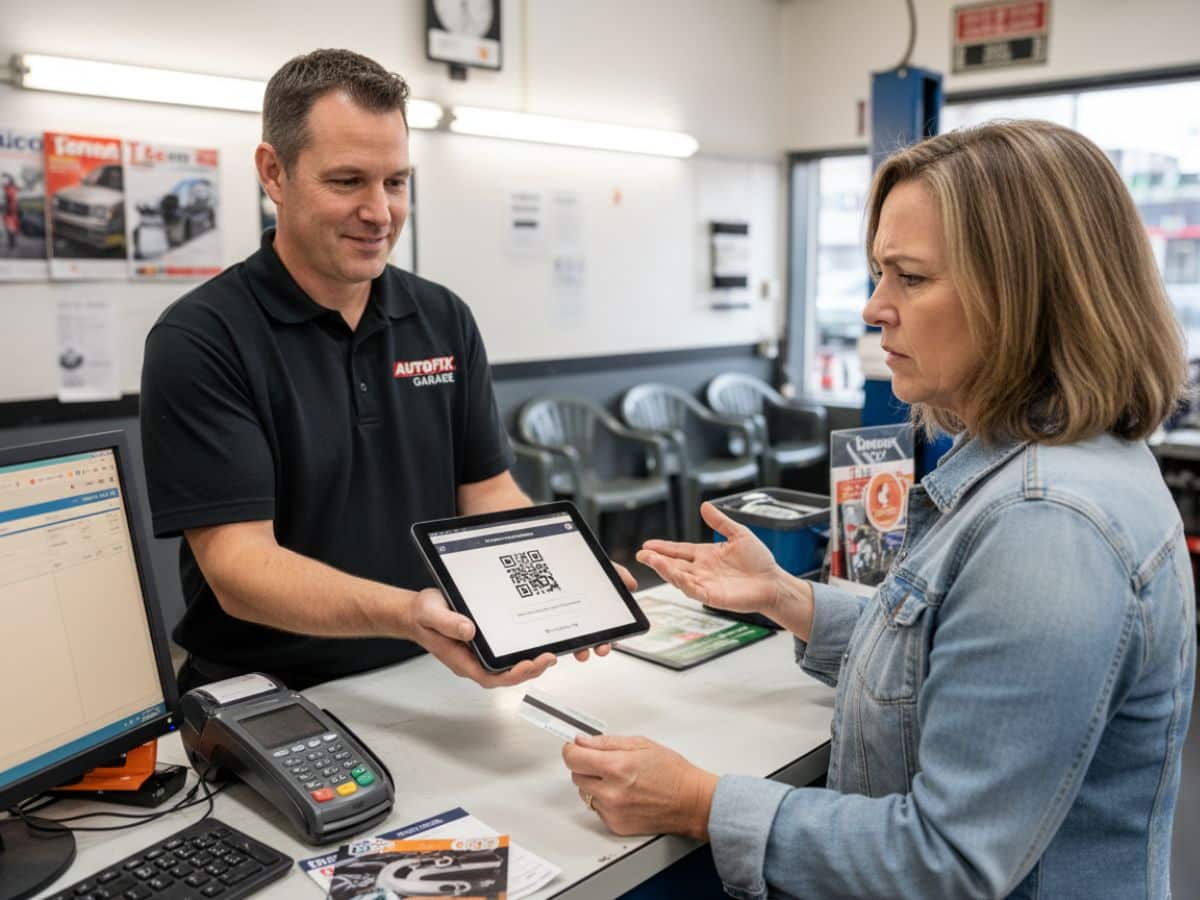
You are not allowed to force reviews at the counter, stand over customers while they write them, or run “review kiosks” on a shared shop tablet or computer that funnels lots of reviews from the same device/IP. 

Earlier, I drew too straight a line between “point‑of‑sale ask” and “reviews getting removed.” The more accurate line, based on Google’s current policies and enforcement, is between coerced, on‑premise, same‑device patterns and voluntary, customer‑driven reviews that often happen later on the customer’s own device.

This article is written with those 2025–2026 policies in mind and links to the relevant Google support pages at the end.

What Google Actually Reads When It Reads Reviews

Most shop owners think Google reads one thing: the number next to the star icon. It reads four. And if you only build for the first one, you spend six months collecting reviews and barely move in the local pack.

What Google Actually Reads When It Reads Reviews

The shops winning the 3‑pack are not the ones with the highest raw count. They are the ones producing all four at the same time. A 2025 study of 2,260 auto repair Google Business Profiles found Position 1 shops averaged a bit over 2,100 reviews while Position 10 shops averaged just under 1,900.

The gap is real but smaller than you might expect, and what closes it on the way up is rarely raw volume alone. It is velocity, recency, and response, applied for twelve months in a row.

The first read: if you have 47 reviews, zero in the last 90 days, and you have never replied to a single one, you do not have a review problem. You have a review *engine* problem. The fix is the engine, not a one‑week push. Reviews are also the second subsystem in how to rank in the Google 3-pack for mechanic near me, and they only count once your Google Business Profile is consolidated into one listing. The content side of the same reputation engine is what to post on social media for your auto repair shop.

The Five‑Touchpoint Review Request Stack

Reviews come from one of two places. Customers who love you so much they go look up your Google listing on their own (rare), or customers you asked at the right moment in the right way (everyone else). The owners who quietly stack 15 to 25 new reviews a month are not begging. They built a pipeline.

The Five‑Touchpoint Review Request Stack

Here is the stack, in the order it needs to be built. Skipping the foundation is the single most common reason a “review automation” rollout disappoints.

1. Clean customer data is the fuel. Without it, nothing else runs.

1. CLEAN CUSTOMER DATA IS THE FUEL. WITHOUT IT, NOTHING ELSE RUNS.

Every review request, automated or manual, starts with a mobile number and an email address attached to the right repair order. If your shop management system has 40 percent of customer phone numbers as the front desk landline, or last names misspelled, or no email field filled in, the most expensive automation tool on the market will sit idle.

The fix is unglamorous. Train the service writer to confirm phone and email at intake. Add a one‑line check at checkout. Audit the database once a quarter for blanks and obvious typos. This is the foundation. Every other layer in the stack feeds from it.

2. Automated SMS and email within two hours of completion

2. AUTOMATED SMS AND EMAIL WITHIN TWO HOURS OF COMPLETION

The two‑hour window after a customer drives away is the warmest moment they will ever feel about your shop. The car runs right, the bill matched the estimate, the bay smelled like coffee, not solvent. That is when you ask. Wait three days and the feeling is gone, replaced by whatever the next car or kid or boss is making them feel.

The mechanics of it:

$

A text message with one short sentence and one link to your Google review page. No survey. No five‑step form. One tap, one screen, one review. 

$

A follow‑up email if the SMS did not land, sent the next morning. Same link. Slightly longer note thanking them by first name. 

$

Never both at once. The two‑hit pattern reads as nagging. SMS first, email as the gentle second pass. 

$

Stop after two attempts per RO. If they did not leave one, they did not want to. Asking a second or third time a week later is how shops earn the “annoying” reputation that the original Reddit question worried about.

This single layer, done well, is the difference between a shop adding 2 reviews a month and a shop adding 15.

From a policy standpoint, this pattern is exactly what Google expects: a business asking for **voluntary** reviews via direct communication and a review link. You are not gating, not incentivizing, and not pressuring them in the waiting room.

3. The in‑person ask at checkout (without pressure)

3. THE IN‑PERSON ASK AT CHECKOUT (WITHOUT PRESSURE)

Automation is the heaviest lifter, but the in‑person ask still out‑converts every channel by 2 to 3 times per attempt. A service writer who looks the customer in the eye and says:

“If today was a good experience, you’ll see a text and email from us later today with a link to our Google page. A quick review really helps independent shops like ours stay visible.”

…books reviews at a rate the SMS alone never matches.

This is staff training, not technology. Script it. Practice it in your Monday huddle. Reward it. The shops that ignore this layer leave 30 to 40 percent of available reviews on the floor.

The nuance, in light of Google’s current rules:

$

You can invite a review at the counter. 

$

You should not require a review at the counter or make it feel like part of the checkout process. 

$

You should let customers complete the review on their own device and time, usually after they leave, which lines up with Google’s emphasis on voluntary, unbiased reviews. 

Earlier, I was too aggressive in saying “stop asking at point of sale.” The more accurate best practice is: keep the in‑person ask, remove the pressure and the expectation that it must happen right there.

4. QR codes on receipts, cards, and the lobby wall (used the right way)

4. QR CODES ON RECEIPTS, CARDS, AND THE LOBBY WALL (USED THE RIGHT WAY)

Friction kills review intent. Every step between “I want to leave a review” and “review submitted” loses about half the audience. A QR code printed on the bottom of every receipt, mounted on a small acrylic stand in the lobby, and printed on a small card your service writer can hand to the customer as they leave removes the typing. Phone camera, tap, review screen, done.

Use a QR generator that points to your Google review write link directly, not your homepage. Test it monthly. Print fresh stickers when one fades.

Google’s own Business Profile help content tells you to create a review link or QR code and add it to receipts and in‑store materials, as well as sharing the link by email or message. That is the pattern they consider normal: you make it easy for customers to find your review form, but they choose*when and how to use it.

What not to do with QR codes, given the current rating‑manipulation and fake‑engagement rules:

$

Do not set up a “review station” on a shop tablet or desktop and walk every customer through leaving a review on that one device while they are still in the shop.

$

Do not herd customers into scanning the QR and writing the review before they can leave, or make the interaction feel mandatory. 

Those patterns risk being read as coerced, coordinated engagement and can fall under Google’s definition of rating manipulation or fake engagement, which can lead to reviews being filtered or profiles restricted.

5. Owner response to every review, good and bad, within 24 hours

5.-OWNER-RESPONSE-TO-EVERY-REVIEW-GOOD-AND-BAD

This is the cheapest, fastest, most ignored move on the entire list. Google reads response rate as a quality signal, and customers read responses before they decide whether to call you. The response to a negative review, done well, is often a bigger conversion lever than the review itself.

Good responses are short. Thank by name. Reference the work done. For negative ones, acknowledge the issue, do not argue in public, and offer a direct phone number to make it right. Five sentences max. The owner or general manager handles them, not a bot, not an offshore service. People can smell a templated response in two seconds.

The honest version: most shops install the automation, skip the data hygiene, never train the in‑person ask, and then wonder why the tool “did not work.” The tool worked. The tool fired into a database full of bad numbers and nobody at the counter said the right sentence at checkout.

What Not to Do, in Plain Terms (with 2025–2026 policy updates baked in)

WHAT NOT TO DO, IN PLAIN TERMS (WITH 2025–2026 POLICY UPDATES BAKED IN)

A few moves look like shortcuts and are not. They are torque applied in the wrong direction, and they break things.

Google’s own policy pages explicitly ban incentives, coercion, and campaigns designed to unfairly inflate ratings or suppress honest feedback. Translating that into shop‑floor language:

$

Do not offer discounts, free oil changes, or any incentive in exchange for reviews. Google’s policies treat incentivized reviews as fake engagement and can remove them or restrict your profile. 

$

Do not buy reviews. Ever. Bought reviews create exactly the kind of pattern Google’s spam systems look for: sudden bursts from accounts with no history or that have reviewed many unrelated businesses. 

$

Do not gate the request based on customer mood. Some agencies pitch “review funnels” that ask the customer first if they had a good experience, and only send the happy ones to Google. This manipulates the rating and violates the requirement that reviews reflect the full range of genuine customer experiences.

$

Do not send the same customer a review request after every visit. Once per customer, per major repair, is the cadence. Customers who like you and have already left one do not need to be asked again next month. 

$

Do not set review quotas for your staff or script what customers should say. Recent guidance highlights that tying employee performance to review counts or coaching customers to mention specific staff or services crosses into rating manipulation and can get those reviews flagged. 

$

Do not set up in‑shop “review kiosks” or require on‑the‑spot reviews at checkout. Forcing customers to leave a review before they can leave, or funneling a high volume of reviews through the same device/IP, looks like coordinated fake engagement and is specifically warned against in Google’s fake‑engagement and rating‑manipulation guidance. 

$

Do not let your front desk forget the ask because the system is automated. The automation is the floor. The in‑person ask is the multiplier. Both need to be working — but the ask must stay voluntary and low‑pressure.

If you have heard “you can never ask for a review at the counter anymore, you can only email,” that is an **overstatement** of Google’s actual rules. The real red lines are incentives, gating, coercion, and manufactured patterns, not the fact that a human being politely said “a review would help us” at checkout.

The Math, the Way a Shop Owner Runs It

Here is where the abstract idea of “more reviews” turns into a number you can put on a P&L.

Start with conversion. A Google Business Profile with 47 reviews at a 4.4 average star rating converts visitors to calls at one rate. The same profile, with 250 reviews at the same star rating, converts at a meaningfully higher rate. Industry research on local search consistently shows that crossing the 100‑review threshold, then the 200‑review threshold, lifts call conversion in noticeable steps. The exact lift varies by category, but the direction is settled.

Now layer in pack ranking. Higher review volume plus active velocity plus response rate is one of the top contributors to local pack position. Moving from page two into the 3‑pack roughly doubles to triples the volume of clicks the listing receives, depending on the search and the city. Combine the conversion lift with the click lift and you have a multiplicative effect, not an additive one.

Run a real number. Say your shop’s average repair order is 450 with a 50 percent gross margin, so 225 gross profit per RO. Suppose the review engine, built and run for nine months, adds:

- 6 extra incoming calls per week from improved pack visibility 
- A 10 percent lift in call‑to‑booking rate from the social proof of higher review counts and active responses 

That is roughly 25 additional calls per month, of which the lift on conversion produces about 12 to 15 incremental bookings. At 225 gross profit per RO, that is 2,700 to 3,375 in additional gross profit per month, every month, with the channel still compounding because reviews from this month feed next month’s ranking and conversion both.

review velocity

The compounding part is the point. We worked with an independent European auto repair shop in the Inland Empire whose cost per lead at the start of an engagement was sitting in the high 80s. Over a 16‑month build, with the review engine running as one piece of a larger system rebuild, the same shop’s cost per lead settled into the mid teens. The review engine was not the only lever, but it was the one whose effect kept accelerating. Reviews stacked. Velocity stayed steady. The listing got read as alive, trustworthy, and prominent, all at once.

The compounding part again, because owners miss it the first time: every review you collect this month is still working for you in month 24. Unlike paid ads, reviews are equity. They do not turn off when the budget runs out.

What to Do This Week, in Order

If you can give this one afternoon and one staff meeting, do it in this order:te

  1. Pull your current review count and compare it to your nearest 3‑pack competitor. The gap is your project. Write it on a whiteboard where the team sees it daily.
    2. Audit the last 30 ROs in your shop management system. Count how many have a clean mobile number and email. If it is less than 80 percent, the data layer is your first fix, before any automation goes in.
    3. Pick one automated review request tool you can deploy this month. Tekmetric, Autoflow, AutoVitals, or a stand‑alone like Birdeye or Podium. Pick on integration with your SMS, not on feature count.
    4. Write the 12‑word script your service writer says at checkout. Put it on a small card by the register. Practice it Monday morning until it does not sound rehearsed. Make sure the script invites a voluntary, later review — it should never sound like a condition of service.
    5. Reply to every review on your profile from the last 90 days, today. Yes, every one. Five sentences max. Thank by name when you can. For the negative ones, acknowledge the issue and offer your direct line. This single afternoon of work moves your response rate score immediately.

That is the diagnostic. None of it is glamorous. All of it is mechanical. The shops that do it for nine months in a row do not have a review problem at month twelve. They have a review engine that produces leads at a cost that keeps falling.

Policy references (current as of April–May 2026)

$

Maps user‑generated content policy — overview of what Google accepts and removes in reviews and other contributions.

$

Prohibited & restricted content (includes rating manipulation rules) — details on incentivized, biased, or otherwise non‑genuine reviews.

$

Fake engagement – Maps User Generated Content Policy — defines fake engagement and how it applies to reviews and ratings.

$

Business Profile restrictions for policy violations — how Google can limit reviews or visibility on a profile when it detects violations.

$

Create a Google link or QR code to request reviews — shows how to generate and share a review link or QR code (including on receipts and in‑store), with a reminder that reviews must be genuine and not incentivized.

$

Tips to get more reviews — best practices for asking customers to visit a Google link or scan a QR code to leave reviews.

$

Manage customer reviews — how to read and reply to reviews, and how to share a review request link or QR code.

$

About missing or delayed reviews — why some reviews don’t show and how policy enforcement can temporarily hide or remove them.

$

Report inappropriate reviews on your Business Profile — how to flag reviews that violate Google’s policies.

Sources for the policy links and patterns above are taken directly from current Google Business Profile help and Maps contribution policy pages. [support.google]

Auto Repair SEO Cost, Is It Worth It?

Auto Repair SEO Cost, Is It Worth It?

Is SEO Worth $1,000 to $1,500 a Month for a Small Auto Repair Shop?

A practitioner's breakdown of auto repair SEO cost, what the spend actually buys, and how to tell an investment from a leak.

A shop owner forwards me a quote almost every week.

Some agency wants $1,200 a month for SEO.

Twelve-month contract. The owner reads it, gets a knot in his stomach, and asks the only question that matters: is this an investment, or a leak I won't notice until the bank balance tells me?

That is the real question. Not "does SEO work." SEO works.

The question is whether this spend, on this shop, at this moment, is money put to work or money quietly draining out the back.

Those are very different things, and the quote in your inbox does not tell you which one you are looking at.

So let's run it the way you'd run a diagnostic on a car that's pulling to one side.

We're not going to guess. We're going to check the actual systems, look at the actual numbers, and tell you what the readings mean.

By the end you'll be able to look at that $1,200 quote and know whether to sign it, renegotiate it, or put it down and fix something else first.

What $1,000 to $1,500 a Month Actually Buys

Mechanic shop SEO pricing is all over the map, and the spread is not random. It tracks what you actually get. Here is the honest market, from a shop owner's point of view.

Price range What it usually is Who it fits
DIY / $0 to $100/moYou optimize your own Google Business Profile, post updates, ask for reviews by hand. Maybe a cheap tool.An owner with real time and discipline. Most owners do not have either.
$300 to $600/moLocal SEO basics: GBP management, a handful of optimized pages, review requests, light reporting.A single-bay-heavy shop testing the water, or one with a clean intake system already in place.
$1,000 to $1,500/moMid-tier local SEO: GBP optimization, service and city pages built on purpose, an active review engine, monthly content, real call tracking.An established shop with a working front desk that wants to own its local map, not just appear on it.
$1,500 to $2,500+/moFull-service: everything above plus aggressive content production, link work, multi-location coverage, sometimes paid traffic bundled in.Multi-location operators or shops in genuinely competitive metros.

Here is where shop owners get burned. They pay a $1,200 mid-tier price for what is functionally a $400 service. The agency manages the GBP, sends a few review texts, publishes one thin blog post a month, and reports on "impressions." The price says investment. The deliverables say leak.

The opposite mistake is just as expensive. An owner pays $1,500 a month for a full-service package while the shop's phone still goes to voicemail at lunch. That is paying for the Road while ignoring the fact that the car can't start. We'll come back to that, because it's the single most common reason SEO money gets wasted.

The first read: $1,000 to $1,500 a month is a fair price for real mid-tier local SEO. It is a terrible price for managed-GBP-plus-a-blog-post. The number on the quote tells you nothing. The deliverables list tells you everything. What that money should be buying is a position in the map box, which is broken down in how to rank in the Google 3-pack for mechanic near me. The build itself is what we run as local SEO for automotive service businesses. If you are weighing it against paid traffic, compare it to what an auto repair shop should budget for Google Ads.

The Real Question Is Not "Is SEO Worth It." It Is "Which Part of Your Shop Is Leaking?"

The Real Question Is Not Is SEO Worth It. It Is Which Part of Your Shop Is Leaking

Most shops do not have a marketing problem. They have a leak problem.

Money is already going out the door, on a website, on some ads, on a guy who does "the Google stuff," and the owner cannot see where it's draining.

SEO is one component of a marketing engine. Buying it in isolation, without knowing which part of the engine is actually broken, is how good money gets spent on the wrong repair.

We diagnose this with six checkpoints. Think of them as the engine's subsystems. They have a build order, and the order is not optional.

Reliability, Reputation, Reselling, Readiness, Remarketing, Reach

That is the order you build in, from the inside out.

Reliability is the work itself: if the shop can't deliver, marketing just sends more people to a bad experience.

Reputation is what the market says about you when you're not in the room: your reviews, your stars, your velocity.

Reselling is the revenue sitting in your customer database, people who already trust you and haven't been back in a year.

Readiness is what happens when a lead actually shows up: does the phone get answered, does the form get routed, or does it sit in an inbox until Thursday.

Remarketing is the follow-up on the prospects who didn't buy the first time.

And Reach, the last one, is the audience your shop touches: paid traffic, social, and the one you're here for, SEO.

SEO is Reach. Reach is the R you build last. Not because it doesn't matter.

Because pouring fuel into an engine that can't convert it is the most expensive mistake in auto shop marketing.

SEO brings more people to your storefront. If your storefront, your reviews, your phone coverage, your follow-up, can't catch them, you have just paid $1,200 a month to introduce more strangers to your weakest moment.

The honest version: if your shop sits at 40 reviews while the shop across town has 200, or your missed calls go to voicemail and stay there, SEO is the wrong purchase this quarter. Not forever. This quarter. Fix the cheaper leak first, then SEO compounds instead of evaporates.

This is the part most agencies will not tell you, because they sell SEO and SEO is what they want you to buy. But a tactic sold without a diagnosis is a guess with an invoice attached.

The reason to run the six checkpoints first is simple: it tells you whether SEO is the best place for your next dollar right now, or whether $400 spent on a missed-call text-back system would do more for your car count this month than $1,200 on rankings.

The Math, Run the Way a Shop Owner Runs It

The Math, Run the Way a Shop Owner Runs It

You think in average repair order, car count, bay capacity, and ticket average. So let's price SEO in those terms instead of marketing terms. Say your average repair order is $450.

Say your shop nets, after parts and labor, somewhere around 50 percent on that work, so call it $225 of gross profit per RO.

Those numbers vary, plug in your own, but the structure holds.

At $1,200 a month for SEO, your breakeven is not abstract. It is between five and six repair orders a month that you would not have gotten otherwise. That's it. If local SEO brings you six extra cars in a month, the channel paid for itself and the rest is yours.

5 to 6 ROs — the monthly breakeven on a $1,200 SEO spend, at a $450 average repair order and 50 percent gross margin. Everything past that is profit the channel produced.

Now look at the other side of the ledger: cost per lead.

A well-built local SEO program does not just produce leads, it produces cheaper leads over time, because organic rankings and a strong Google Business Profile do not charge you per click.

That is not a discount. That is the channel compounding: the same work that ranked you keeps ranking you, and the lead cost keeps dropping while the lead count climbs.

Compare that to paid ads, where the meter resets every morning. Stop paying, the leads stop that day. SEO has mileage. The content you publish this quarter is still working eighteen months from now.

That is the difference between fuel you burn and equity you build, and it is the entire reason the channel can be worth a four-figure monthly spend even though it feels slow at the start.

The math only breaks in one situation: when the leads SEO produces fall through a leak before they become repair orders.

Which is why the breakeven number above assumes your front desk actually catches the calls.

If it doesn't, recalculate. Your real cost per acquired customer is whatever you paid divided by the few that made it through, and that number can get ugly fast.

What Good Local SEO Actually Includes

If you are going to spend $1,000 to $1,500 a month, you should be able to point at what you are buying. Real mid-tier local SEO for an auto repair shop has three load-bearing components. If a package is missing one, you are paying for activity, not assets.

Google Business Profile optimization, treated as your storefront

1. Google Business Profile optimization, treated as your storefront

Your GBP is the most visible public-facing asset you own. It is your showroom on the digital street. For a "mechanic near me" search, the map pack shows up before the regular results, and most clicks never go past it. Good SEO work means the profile is fully built out, categorized correctly, posting regularly, photographed well, and collecting reviews on a system instead of by accident. We have seen GBP map views go from a few hundred a month to north of seventeen thousand once a profile is actually managed instead of just claimed. That visibility is free traffic, and most shops leave it sitting on the table.

A hub-and-spoke page structure, not one thin Services page

2. A hub-and-spoke page structure, not one thin "Services" page

This is the part cheap packages skip. A hub-and-spoke build means one strong page for a service, the hub, connected to multiple pages targeting the specific towns you serve, the spokes. Brake repair is the hub. Brake repair in your town, brake repair in the next town over, those are the spokes. It builds topical authority and geographic coverage at the same time. A single page that says "we do brakes, AC, diagnostics, and more" ranks for almost nothing, because it is trying to be about everything and ends up being about nothing.

A review engine that runs on a system, not on the owner remembering

3. A review engine that runs on a system, not on the owner remembering

Review velocity, the steady drip of fresh reviews, matters as much as the total count. Google rewards consistency, and so do customers reading them. Good SEO work includes the system that asks every customer, every time, automatically. Reviews are the cheapest, highest-return trust asset a shop owns, and they feed your rankings and your conversion rate at the same time.

How to audit a quote in thirty seconds: ask the agency to point at the GBP plan, the page structure, and the review system. If they get specific, you're looking at real local SEO. If they answer with "content" and "optimization" and "authority building," you're looking at a $400 service wearing a $1,200 price tag.

The Timeline: Why SEO Feels Like Nothing, Then Feels Like Everything

The Timeline Why SEO Feels Like Nothing, Then Feels Like Everything

Here is the part that makes shop owners nervous, and the part bad agencies hide. SEO does not work like ads.

You will not see a result in week two. The honest timeline is three to six months before the curve bends, and the first sixty days can feel like you're paying for nothing.

That is because rankings do not move in a straight line. They move in steps. Google re-indexes, re-evaluates, and then a body of work that looked like it was doing nothing moves all at once.

We watched this on a Southern California RV service and paint operation we work with. For weeks the rankings looked flat. Then a single indexing cycle hit.

15.1 to 4.2 — average organic rank for a Southern California RV service and paint operation, moved in a single indexing cycle and held for seven straight months. The work looked like nothing, until it looked like everything.

That same operation now holds 99 percent of its tracked local pack rankings in the top three, and 49% are at the number one spot. Its monthly website sessions grew 6.5 times over the build.

None of that happened in month one. All of it happened because the work in months one through three was real, even when the dashboard looked quiet.

So the timeline is a feature, not a bug, but only if you understand it going in. The owners who get burned are the ones who were sold a fast result, panicked at the month-two report, and either fired the agency right before the step change or kept paying an agency that was never building anything in the first place.

You need to be able to tell those two situations apart, which means you need leading indicators in your monthly report: pages published, reviews added, map views, query impressions.

Those move before rankings do. If those are climbing, the engine is being built. If those are flat too, that is your answer.

SEO Is Digital Real Estate, and It Has a Replacement Cost

SEO Is Digital Real Estate, and It Has a Replacement Cost

Before this work, I spent years as a real estate appraiser. The instinct never left. When I look at a shop's digital presence, I see an asset with a calculable value, the same way I'd look at a building.

Your page-one rankings, your map pack positions, your reviews, your content library, those are digital real estate.

Fixed supply, variable demand.

There are only three slots in the map pack for "transmission repair near me" in your town.

If you hold one, your competitor does not.

And like any property, that position has equity that compounds and a replacement cost if you lose it.

Here is what that equity looks like in dollars.

An independent European auto repair shop in the Inland Empire we work with pulled 629 organic clicks in a stretch where the going rate for that same click through Google Ads was $2.35.

$1,478 — the paid-traffic cost an independent European auto repair shop in the Inland Empire did not have to pay, because 629 visitors arrived through organic rankings instead. Every organic click is a dollar you didn't hand to Google.

Run that forward. That is not a one-time saving. Those rankings keep producing clicks next month and the month after, at no additional cost per click, while the paid meter would have kept running.

That is the compounding nobody puts on a quote, because it does not show up in month one.

It shows up in year two, when a shop that invested in SEO is pulling free traffic that a shop relying purely on ads is still renting by the click.

This is also why "is SEO worth it" is the wrong frame.

You would not ask if owning the building is "worth it" versus renting forever.

You'd ask whether you can afford the down payment and whether the location is right.

SEO is the same decision. The monthly fee is the mortgage payment on an asset you are building.

The question is whether the shop is in a position to make that payment count.

Red Flags: When That $1,200 Is a Leak, Not an Investment

The spend is not the problem. The wrong spend is. Here is what tells you a $1,200 SEO engagement is going to drain instead of build.

The tactic-seller

The tactic-seller

Any agency selling one channel as the whole answer. SEO-only, with no interest in whether your phone gets answered or your reviews are current, is selling you a wheel and calling it a car. The channel might be fine. The isolation is the problem.

Software dressed up as strategy

Software dressed up as strategy

A platform or a parts company that sells you a tool and calls it marketing. The tool might be useful. A tool is not a strategy, and paying strategy prices for software access is a quiet, recurring leak.

Reporting on impressions and clicks instead of calls and cars

Reporting on impressions and clicks instead of calls and cars

If the monthly report leads with "impressions" and "rankings" but cannot tell you how many phone calls or booked appointments the work produced, the agency is hiding behind vanity metrics. You measure your shop in cars and ROs. Your marketing should be measured the same way.

No call tracking, no conversion tracking, no attribution

No call tracking, no conversion tracking, no attribution

If nobody installed the plumbing to see which leads came from where, then nobody, including you, will ever know if the $1,200 worked. That is not an oversight. That is a leak with a contract.

The fragmented vendor blame cycle

The fragmented vendor blame cycle

You have an SEO guy, a website guy, and an ads guy, and when results are flat the SEO guy blames the website, the website guy blames the ads, and nobody owns the number. Three invoices, zero accountability. The fix is not a better SEO vendor. It is one accountable system.

So Is It Worth It? The Honest Answer

So Is It Worth It The Honest Answer

SEO is worth $1,000 to $1,500 a month for a small auto repair shop when three things are true.

The work is real mid-tier local SEO, not a managed GBP with a price markup.

The shop underneath it can actually catch the leads, so the front desk answers, the reviews are competitive, the follow-up exists. And the owner understands the timeline, so the step change in month four does not get killed by panic in month two.

When those three things are true, the channel compounds.

Cheaper leads over time, free traffic that keeps producing, an asset with real equity.

When even one of them is false, that same $1,200 is a leak you will not notice until the year-end numbers make you look.

The quote in your inbox does not tell you which situation you are in. A diagnosis does. Before you sign a twelve-month SEO contract, find out which part of your shop is actually leaking, because that is the part worth fixing first.

What would SEO have to produce to pay for itself at your shop?

Quotes get priced in impressions. You run your shop in cars. Put your numbers in.

$
%
$
%
If you caught every call

5.3

repair orders
Each car returns $225. A $1,200 spend pays for itself at 5.3 cars a month.
What SEO actually has to deliver

6.6

opportunities
You keep 80% of what the channel brings, so it has to produce 6.6 to net 5.3.
Why this number is still conservative

Missed calls are the only leak counted here, because missed calls are the only one that is plain arithmetic. Miss a quarter of your calls and the channel has to produce a third more to land the same work. No estimating required.

Two other leaks are working on you at the same time, and we are not going to pretend we can put a number on them. If you have no follow-up for the people who call once and do not book, some of what you paid for walks. If your review count sits well behind the shop across town, some of the people who find you in the map pack pick them instead, and you never see it happen.

We do not know the size of either effect at your shop, and nobody honestly does without looking at your numbers. But we know the direction, and it only ever runs one way: both push the real number higher than what is shown above. Treat this as the floor, not the estimate.

Math: spend divided by (repair order times margin) gives the breakeven. That divided by your call capture rate gives what the channel has to produce. A planning tool, not a projection, and not a guarantee of results.

The cheapest way to lower this number is not to negotiate the SEO price. It is to stop dropping the calls you already pay for.

Book a shop audit

Frequently Asked Questions

How much does SEO cost for an auto repair shop?

Auto repair SEO cost runs from near zero for a disciplined DIY effort, to $300 to $600 a month for local SEO basics, to $1,000 to $1,500 a month for real mid-tier work with GBP optimization, purpose-built service and city pages, and a review engine, up to $1,500 to $2,500 or more for full-service or multi-location coverage. The price only tells you something when you read it against the actual deliverables list.

How long before auto repair SEO actually works?

Plan on three to six months before the curve bends. Rankings move in steps, not a straight line, because Google re-indexes and re-evaluates in cycles. The first sixty days can feel like nothing is happening even when the foundational work is real. Watch leading indicators, pages published, reviews added, map views, and query impressions, because those climb before rankings do.

Is local SEO better than Google Ads for a mechanic shop?

They do different jobs. Google Ads is fuel: it produces leads immediately and stops the day you stop paying. SEO is equity: it builds slowly, then keeps producing traffic at no additional cost per click. Most shops eventually want both, but the order matters. Neither one is worth the spend if the shop cannot catch and convert the leads they bring in.

Can I just do SEO myself instead of paying an agency?

You can handle the basics yourself, optimizing your Google Business Profile, posting regularly, and asking every customer for a review. That alone puts you ahead of plenty of shops. The work that is hard to DIY is the page structure, the content cadence, and the consistency, because those compete with your actual job of running a shop. The honest test is whether you have real time and real discipline. Most owners have neither, and that is not a knock, it is just the reality of running a bay.

Why is my current SEO not producing more calls?

Usually one of three reasons. The work being done is thinner than the price suggests. Or the SEO is fine but the leak is somewhere else, the phone goes to voicemail, the reviews are not competitive, the follow-up does not exist, so the traffic arrives and falls through. Or there is no call tracking installed, so the calls are happening and nobody can see them. A diagnosis tells you which one it is.

How do I know if an SEO agency is worth the money?

Ask three specific questions. What is the Google Business Profile plan, what is the page structure, and what is the review system. Specific answers mean real local SEO. Vague answers about "content" and "authority" mean you are likely paying a mid-tier price for an entry-level service. Then check the reporting: if it leads with impressions instead of calls and booked appointments, the agency is measuring the wrong thing.