
They Bought a 58-Year-Old Shop. They Also Bought Its Marketing.

McBride's RV has been fixing RVs in Chino since 1967. When new owners took over, the phone rang because of a website the previous owner had hand-built himself years earlier.
It worked. It was also the ceiling.
Here is what changed in 18 months.
+77%
-24%
+25 spots
171
A lead means a phone call or a form. Not a booked job.
THE SHOP
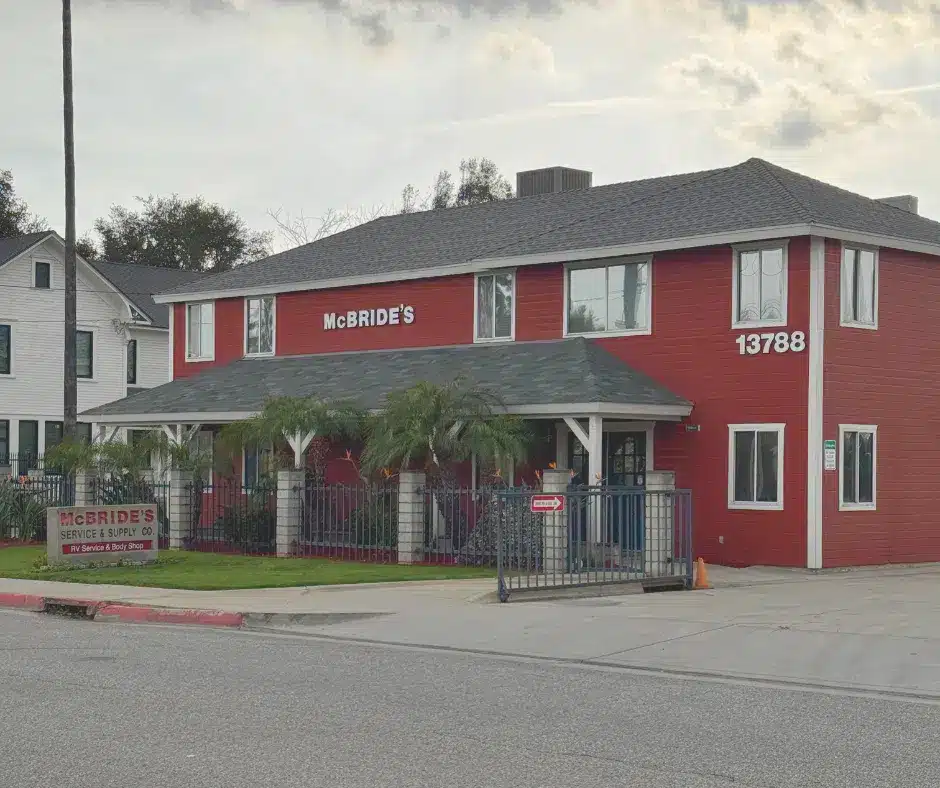
McBride's RV Service & Paint. Chino, California. Family owned since 1967.
They do full collision and paint work in a 40-foot enclosed booth. They fix roofs, A/C units, refrigerators, water heaters, slide-outs, brakes, and generators.
And they handle the whole insurance claim for you. That is the part most RV owners dread.
New ownership took over a shop with 58 years of reputation, a full crew, and a real customer list. What they did not get was a way to grow any of it.
WHAT THEY INHERITED
The previous owner was sharp. He had an engineering background, so he built the website himself and did his own SEO. That is more than most shops ever do.
But it was a hand-coded site from the early 2010s, and it came with three limits.
01
The rankings were real, and they were capped.
The site held position on a handful of terms. It could not go get new ones. Every service the shop actually performed but did not have a page for was a search they could not win. On the terms that mattered, they were sitting on page 4 and page 5.
02
Nothing behind the phone.
No CRM. No follow-up. No record of who called, what they wanted, or whether anyone called them back.
03
No way to prove anything.
There was no lead tracking, so there was no way to know which half of the effort was working. The shop was running on faith and a phone that mostly rang.
Nobody had done anything wrong. The shop had simply outgrown a website built by one person in his off hours.
WHAT WE BUILT

We did not add a channel on top of the old setup. We replaced the foundation first.
A new website.
Built to be found and built to convert. Every service the shop actually performs got its own page, which meant they could finally compete for searches they had never been eligible for.
Real tracking, from day one.
Every call and every form, tied back to where it came from.
A CRM and follow-up system.
So a missed call stops being a lost customer.
The Google Business Profile, worked properly.
Categories, services, photos, reviews, posts.
Paid traffic on top, not instead.
Google Ads and Meta ads, pointed at a site that was finally ready to receive them.
THEN WE TUNED IT
Building it is the first half. Reading the data and cutting what does not work is the other half. Most agencies skip that part because it means admitting something did not work.

We cut our own campaign that was not earning
We read every single search that set off an ad.
One campaign was paying $138 for a single lead. Another was bringing in the same kind of customer for about $15. Only 12 cents of every dollar in the expensive one was reaching real paint and body customers. The rest went to hobby painters, parts shoppers, and people typing in other shops' names.
We shut it down and moved the money where it was already working.

We changed the strategy when search changed
The old playbook was a page for every service in every nearby city. Build enough of them and you cover the map. That worked for years, and it worked here. The site was up to 193 pages.
Then the way people search moved. More of them ask a question and take the answer that comes back, from Google's AI results or from ChatGPT. Nobody is scrolling through near-identical city pages anymore, and the systems choosing the answer do not reward volume. They reward the page that actually answers the question.
So we changed direction. We reviewed all 193 pages one at a time and gave each a keep, merge, or retire decision. Then we rebuilt 10 service pages from the ground up, written to be the answer instead of the listing. Real questions, direct answers, structured the way the AI results pull from.
We stopped making new pages and started making the good ones win.

We put an alarm on the tracking
A website update quietly broke the lead tracking.
We found it, fixed it, and set up an automatic check that runs every morning at 7:31. If it ever breaks again, we know the same day instead of the next quarter.

We watched it every week
Numbers move. That is normal.
When one campaign slipped in April, we caught it fast and had it corrected within days. By June, that same campaign was cheaper per lead than it had ever been.
WHAT HAPPENED
More leads, for less money
First half of 2025 against the first half of 2026. Same six months, one year apart.
| Change | |
|---|---|
| Leads | +77% |
| Cost per lead | -24% |
More calls coming in. Each one costing less to get.
Look at April and May on their own, against the same two months a year earlier: 22% more leads on 8% less ad spend.
We report movement as percentages, not dollars. A client's budget is their business, not our marketing material.
Beating their own goal
McBride's set the target at under $30 per lead.
They have been under it every month since we finished the rebuild, and by a wide margin.
Off page
| The old site | Now | |
|---|---|---|
| Where they showed up | Page 4 or 5 | Page 2 |
| Average jump | 25 spots |
They are now #1 in Chino for: RV repair shop, RV body repair, RV A/C repair, RV service, RV service near me, and motorhome repairs near me.
Those are rankings the old site was never built to reach.
And everywhere else
- Website visits: up 27%
- Google Business Profile views: up 39%, their best month in the record
THE PART THAT SURPRISED EVERYONE.
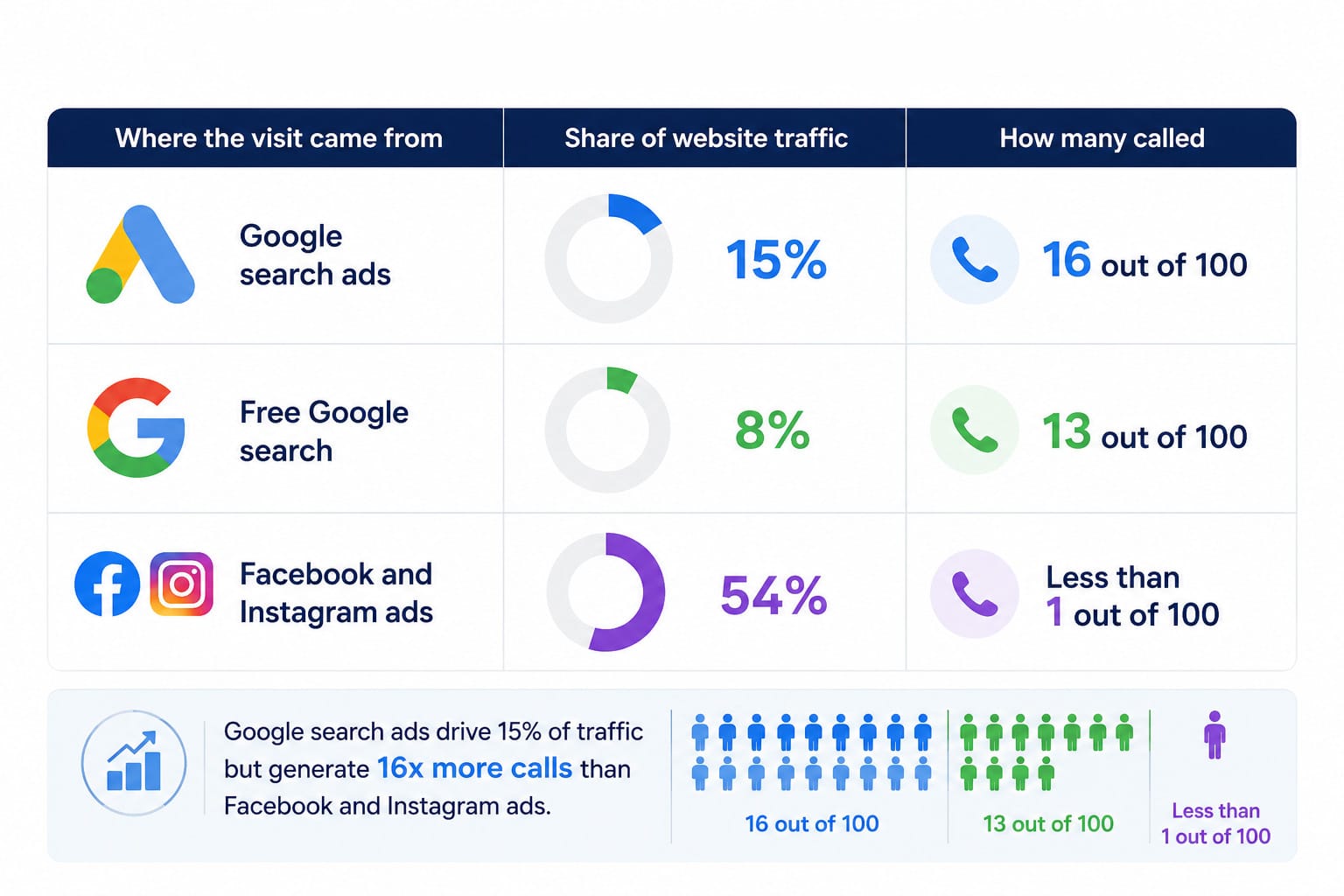
We tracked where every single lead came from. Here is what came back.
Facebook was sending more than half the traffic. It was sending almost none of the calls.
That is not a reason to quit Facebook. It is a reason to know what each channel is actually for. One fills the top of the funnel. One fills the bays.
Most shops never run this check, because most shops cannot. It only works if the tracking was built in from the start.

WHAT WE ARE WORKING ON NOW
McBride's shows up in more places than the shop ever has. But more eyeballs did not turn into proportionally more phone calls.
That is not an ad problem. You cannot fix it with a bigger budget.
So we went after the phone instead:
- A text goes out automatically when a call gets missed
- A 3 to 5 minute answer standard, with a chat box on the website
- Alerts that keep nudging until a real person picks it up, then stop
- A review request that actually lands in the inbox instead of the promotions tab
We will report those numbers when we have them.
WHY IT WORKED
We replaced the foundation before we spent a dollar driving traffic to it.
Ads pointed at a website that cannot convert or track is just a faster way to lose money.
We changed the plan when the ground moved.
The city-page playbook worked until AI answers started eating the click. We rebuilt for how people search now instead of defending what used to work.
We checked the wiring, not just the report.
Two of the biggest wins were things broken in ways no dashboard would show you.
One team ran all of it.
Ads, search, the Google profile, the website, and the follow-up. When five vendors run five pieces, the pieces fight. Ours pass work to each other.
When a number went the wrong way, we said so.
Then we fixed it.
We do not publish our clients' numbers.
Every result above is a percentage or a count, on purpose. You will not find this shop's budget, ticket average, or revenue anywhere in our marketing, because a competitor could read it as easily as you can. If an agency ever shows you another shop's dashboard, ask yourself what they are showing that shop.
Just Bought a Shop? You Inherited Its Marketing Too.
That was McBride's. Fifty-eight years of reputation, a good crew, and a website doing all it could with what it was.
What they did not have was a system where every piece knew what the other pieces were doing.
We only work with one shop per category, per territory. If yours is open, we will show you exactly where you stand before you commit to anything.
No sales pitch. Just clarity.

SHORT FAQ
We just took over a shop. Do we have to start from zero?
No. You start from whatever the last owner built, and usually that is worth keeping. The question is whether it can grow. A site that holds six rankings is not the same as a site that can go earn sixty.
How long did this take?
The ad results showed up in the first full month. Google search took longer. It moved in two big steps, about three months and about eight months in. That is normal. Plan on 60 to 90 days before search moves.
Why are the results percentages instead of dollars?
Because a case study is public and a competitor can read it. Publish enough raw numbers and anyone can work backward to a shop's ad budget and roughly what it makes. We do not do that to our clients, and we would not do it to you. The percentages are pulled from the same account data either way.
Does "lead" mean a booked job?
No. A lead is a phone call or a form. We do not report booked jobs, because what happens after the phone rings is up to the shop.
Would this work for my shop?
Every market is different. What stays the same is the order of the work. Fix the foundation. Cut what is wasting money. Then build.
Do you work with my competitors?
No. One shop per category, per territory. Once a territory is taken, we turn everyone else in that category away.